Saga Byrne, younger sister of the hero Vista, wakes up in the hospital in January 2011, with access to the Celestial Grimoire, a strange new power that reshapes the world around her. Alongside it come vague memories from another life that hint at a greater pattern behind her second chance.

Navigation
Install the app
How to install the app on iOS
Follow along with the video below to see how to install our site as a web app on your home screen.
Note: This feature may not be available in some browsers.
More options
-
An addendum to Rule 3 regarding fan-translated works of things such as Web Novels has been made. Please see here for details.
-
We've issued a clarification on our policy on AI-generated work.
-
Our mod selection process has completed. Please welcome our new moderators.
-
Due to issues with external spam filters, QQ is currently unable to send any mail to Microsoft E-mail addresses. This includes any account at live.com, hotmail.com or msn.com. Signing up to the forum with one of these addresses will result in your verification E-mail never arriving. For best results, please use a different E-mail provider for your QQ address.
-
The rules regarding NSFW links have been updated. See here for details.
You are using an out of date browser. It may not display this or other websites correctly.
You should upgrade or use an alternative browser.
You should upgrade or use an alternative browser.
Celestial Saga
- Thread starter Oblation
- Start date
![Celestial Saga [Worm Alternate Timeline]](/data/threadmark-index-icons/l/24/24711.jpg?1764877358)
Celestial Saga [Worm Alternate Timeline]
- Created
- Status
- Hiatus
- Watchers
- 76
- Recent readers
- 0
- Threadmarks
- 117
-
Loading…
-
Statistics (7 threadmarks, 19k words)
User Total Oblation 7 Threadmarks Reader mode RSS- Words
- 2k
More options
Who Replied?
Threadmarks
View all 110 threadmarks
Reader mode
Reader mode
Recent threadmarks
110: Advertisement for Uber and Leet on the Villain Hiring site "Blacklist" - 8/3/11 109: Monday, August 1st - Star Trek Full 108: Sunday, July 31st - Helltaker 107: Saturday, July 30th - Tsunade's Taijutsu Training 106: Thursday July 28th - MHA Day 2-7 and Wards IRC Mini 105: Wednesday July 27th - MHA - Day 1 104: Sunday, July 24rd - Girls Night 103: Saturday, July 23rd - Pocket Space and Hugs
Extras
View all 7 threadmarks
Reader mode
Reader mode
Recent threadmarks
Celestial Saga: Lore - Chapter 4: Saga's Earth-Bet's Version of the Movie "UP" Celestial Saga: Star Wars on Earth-Bet - Episode VIII: Legacy of Hope Celestial Saga: Star Wars on Earth-Bet - Episode VII - Rebirth of Hope Celestial Saga: Behind the Scenes - On Non-Shard Powers and a bit of what Cauldrons been up to... Celestial Saga: Lore - Chapter 3: The Table-Turners: The Story of Adam, Eve, and the Dangers of Power and Influence. Celestial Saga: Lore - Chapter 2: Character Backstory: Saint-Moses-the-Black or the man formally known as Geoff Pellick Celestial Saga: Lore - Chapter 1: Media in the Celestial Saga Timeline
Celestial Saga: Lore - Chapter 1: Media in the Celestial Saga Timeline

Oblation
Professional Wet-Paint Observer
- Joined
- Nov 25, 2024
- Messages
- 403
- Likes received
- 4,256
Something that I'm fairly certain won't really get discussed in Celestial Saga is the state of the Video Game, TV, Movie, and Animation Industries on Saga-Bet as opposed to IRL.
Because, as stated in chapter 1, Saga didn't gain anything all that personal from me, or much in the way of my education, but still got most of my media knowledge.
So she's free to talk about all sorts of Earth IRL media, or to recognize it when it shows up on the Celestial Grimoire.
But as I've previously hinted at, this Version of Earth Bet started to diverge from our timeline in the 1800s, with the ripples first starting to show in the 1920s and things becoming visibly different during and especially after WW2.
Someday, I will hopefully have the time to fully explain that, but the simplified version is that this is a comic book universe, not a cinematic one.
So it's all fine and dandy to remember that Scion showing up in 1965, not 1982, means that Contessa killed Eden in the '60s, not '80s, and would be nearing 60 if she were alive today.
But entirely something else to realize that this was STILL a comic book universe before Scion showed up.
There was Sherlock Holmes and Father Brown types running around in the 1880s and 1890s, there were the occasional Magical animal or miraculous event during WW1, and the 1920s and 1930s had a bunch of different stories starting to pop up, so that by the 1950s, there were outright superheroes popping up all across the world.
They were still at the "peak human" or "more slight of hand than actual witchcraft" end of things back then, but escalation is in the bones of Earth-Bet, so if it weren't Scion showing up, something would've happened in the '60s or '70s.
But there is also the downside to all this:
With greater excitement, the dangers are also increased.
With Heroes come all sorts of low-level criminals and criminal organizations.
Which is fine if you're a superhero or a Sidekick, but if you're a typical person, that means most cities seemed to be absolutely crawling with small-to-medium gangs and crime after WW2.
So that by the time that Earth-IRL's media starts to explode in terms of amount and quality, Bet has gotten used to a world where, if there's a big, popular Movie, Game, or TV studio, it's just a matter of time before a Villain attacks, mind controls, or does some other no doubt nefarious thing to it.
Meaning that most sensible people treat those kinds of places like a hot zone in a war.
Which inevitably means they have trouble getting staff, and thus even continuing their existing media, much less rapidly increasing output.
But, a lot of the pressures that caused so much media in the IRL '90s and after are still present, even if people no longer trust Big Name media companies to finish their projects.
So what you get is Indie-Films.
And Indie-Games.
And even the occasional Indie TV show.
Although that last one is very different as their still considered mildly dangerous to make, so they're mostly designed to tell their entire story in a single season.
This is even somewhat self-reinforcing, given the time the Slaughterhouse 9 decided to try making a movie, they did it by going to where an Indie studio was risking making a third season of a popular show in the mid '90s and hijacking (then later slaughtering) the crew and actors.
Still, in North-America, by 2011, most media comes in the form of what we would consider Indie Studios.
Lots of them will have budgets worth several million, or even tens of millions, to make their project.
But unlike IRL, movies aren't getting 100-200 million dollar budgets just by default.
Also, the timeline tends to be more compressed.
Traditional wisdom for film crews and game devs is that if you want to live in a single city, then you never join a project that's been in progress for more than 8 months, and always leave a project after a year, regardless of where it's at in development.
There are, of course, plenty of Videographers, devs, and the like willing to move from city to city between jobs and so tend to be better paid under the assumption they'll stick out the full 1.5-2 year creation process before moving on.
Not to mention all the work that can be done remotely, generally is.
It's usually not even that dangerous to work for a company that contracts out programmers or editors to other projects.
Other than the risk of the Villins choosing to steal the company's computers during the day, instead of the middle of the night, like they should.
There are also a larger number of Passion projects than IRL.
Which is how Games like Undertale, Stardew Valley, and Terraria still manage to exist on Bet.
Generally, the way that an Indie-Dev becomes an Indie-Dev-Studio owner is that after 5 to 15 years of working on other people's projects while hammering away at their passion project, they finally finish it (or at least get it to a usable state), and it manages to do pretty well.
After that, they'll get the funding and support for 10 to 20 staff, but suddenly be under the typical 2-year deadline, with the added pressure of staff who consider it standard to leave projects partway through and so won't hesitate if a better offer comes along.
So while Earth-Bet America and Europe do actually have thriving Game and Movie communities, they are decidedly different from their equivalents on Earth-IRL or even the comparatively more stable Earth-Aleph.
All that's not to say that larger projects aren't getting made, however.
Just that, unlike IRL, America and Europe aren't the driving force behind that kind of project.
But for people who like the More action packed bombastic movies that are harder to make on a smaller budget, Bollywood is happy to provide.
And the people who are willing to spend more on the equipment and titles of their games will find a certain handful of AAA games coming out of China, even though the media limitations imposed by the Imperial Censorship Bureau.
(Though even AAA games on bet are usually some kind of single-player or Co-Op thing, given how expensive it is to get a decent internet connection across a continent, much less across the world.)
And on the Visual arts side, Anime is starting to make a comeback after a dip following Kyushu.
While Japan's economy and population have certainly shrunk, there are still tens of millions of people there, and their cities aren't so dangerous that things like animation become completely impossible.
The Anime Industry is smaller, and due to the first CUI Emperor considering it to be "Degenerate," Chinese and Korean anime never really became a thing.
But on the other hand, there's less pressure for Anime studios to conform to a familiar art style or to pump out their media as fast as possible.
So, Anime in general has started to be exported again, and includes some true Gems for those international viewers who remember the hits exported in the '90s.
Korea, on the other hand, has taken quite strongly to cell-phone culture and begun creating some highly compact games and stories where a cellphone is the intended medium, rather than shrunk down to fit on one.
As a result, there has been a quickly growing community of authors, devs, and artists across the world creating projects explicitly designed for phones, and where the final price won't exceed $3.99.
In the end, I hope you can get how the Earth-Bet Saga is living in has a ton of media around and isn't simply the more Generic Earth-IRL shown in Canon.
But at the same time, this is a world that is effected, not just in the large strokes but also the small ones, by the continual escalation of powers, mysteries, and conflicts.
Because, as stated in chapter 1, Saga didn't gain anything all that personal from me, or much in the way of my education, but still got most of my media knowledge.
So she's free to talk about all sorts of Earth IRL media, or to recognize it when it shows up on the Celestial Grimoire.
But as I've previously hinted at, this Version of Earth Bet started to diverge from our timeline in the 1800s, with the ripples first starting to show in the 1920s and things becoming visibly different during and especially after WW2.
Someday, I will hopefully have the time to fully explain that, but the simplified version is that this is a comic book universe, not a cinematic one.
So it's all fine and dandy to remember that Scion showing up in 1965, not 1982, means that Contessa killed Eden in the '60s, not '80s, and would be nearing 60 if she were alive today.
But entirely something else to realize that this was STILL a comic book universe before Scion showed up.
There was Sherlock Holmes and Father Brown types running around in the 1880s and 1890s, there were the occasional Magical animal or miraculous event during WW1, and the 1920s and 1930s had a bunch of different stories starting to pop up, so that by the 1950s, there were outright superheroes popping up all across the world.
They were still at the "peak human" or "more slight of hand than actual witchcraft" end of things back then, but escalation is in the bones of Earth-Bet, so if it weren't Scion showing up, something would've happened in the '60s or '70s.
But there is also the downside to all this:
With greater excitement, the dangers are also increased.
With Heroes come all sorts of low-level criminals and criminal organizations.
Which is fine if you're a superhero or a Sidekick, but if you're a typical person, that means most cities seemed to be absolutely crawling with small-to-medium gangs and crime after WW2.
So that by the time that Earth-IRL's media starts to explode in terms of amount and quality, Bet has gotten used to a world where, if there's a big, popular Movie, Game, or TV studio, it's just a matter of time before a Villain attacks, mind controls, or does some other no doubt nefarious thing to it.
Meaning that most sensible people treat those kinds of places like a hot zone in a war.
Which inevitably means they have trouble getting staff, and thus even continuing their existing media, much less rapidly increasing output.
But, a lot of the pressures that caused so much media in the IRL '90s and after are still present, even if people no longer trust Big Name media companies to finish their projects.
So what you get is Indie-Films.
And Indie-Games.
And even the occasional Indie TV show.
Although that last one is very different as their still considered mildly dangerous to make, so they're mostly designed to tell their entire story in a single season.
This is even somewhat self-reinforcing, given the time the Slaughterhouse 9 decided to try making a movie, they did it by going to where an Indie studio was risking making a third season of a popular show in the mid '90s and hijacking (then later slaughtering) the crew and actors.
Still, in North-America, by 2011, most media comes in the form of what we would consider Indie Studios.
Lots of them will have budgets worth several million, or even tens of millions, to make their project.
But unlike IRL, movies aren't getting 100-200 million dollar budgets just by default.
Also, the timeline tends to be more compressed.
Traditional wisdom for film crews and game devs is that if you want to live in a single city, then you never join a project that's been in progress for more than 8 months, and always leave a project after a year, regardless of where it's at in development.
There are, of course, plenty of Videographers, devs, and the like willing to move from city to city between jobs and so tend to be better paid under the assumption they'll stick out the full 1.5-2 year creation process before moving on.
Not to mention all the work that can be done remotely, generally is.
It's usually not even that dangerous to work for a company that contracts out programmers or editors to other projects.
Other than the risk of the Villins choosing to steal the company's computers during the day, instead of the middle of the night, like they should.
There are also a larger number of Passion projects than IRL.
Which is how Games like Undertale, Stardew Valley, and Terraria still manage to exist on Bet.
Generally, the way that an Indie-Dev becomes an Indie-Dev-Studio owner is that after 5 to 15 years of working on other people's projects while hammering away at their passion project, they finally finish it (or at least get it to a usable state), and it manages to do pretty well.
After that, they'll get the funding and support for 10 to 20 staff, but suddenly be under the typical 2-year deadline, with the added pressure of staff who consider it standard to leave projects partway through and so won't hesitate if a better offer comes along.
So while Earth-Bet America and Europe do actually have thriving Game and Movie communities, they are decidedly different from their equivalents on Earth-IRL or even the comparatively more stable Earth-Aleph.
All that's not to say that larger projects aren't getting made, however.
Just that, unlike IRL, America and Europe aren't the driving force behind that kind of project.
But for people who like the More action packed bombastic movies that are harder to make on a smaller budget, Bollywood is happy to provide.
And the people who are willing to spend more on the equipment and titles of their games will find a certain handful of AAA games coming out of China, even though the media limitations imposed by the Imperial Censorship Bureau.
(Though even AAA games on bet are usually some kind of single-player or Co-Op thing, given how expensive it is to get a decent internet connection across a continent, much less across the world.)
And on the Visual arts side, Anime is starting to make a comeback after a dip following Kyushu.
While Japan's economy and population have certainly shrunk, there are still tens of millions of people there, and their cities aren't so dangerous that things like animation become completely impossible.
The Anime Industry is smaller, and due to the first CUI Emperor considering it to be "Degenerate," Chinese and Korean anime never really became a thing.
But on the other hand, there's less pressure for Anime studios to conform to a familiar art style or to pump out their media as fast as possible.
So, Anime in general has started to be exported again, and includes some true Gems for those international viewers who remember the hits exported in the '90s.
Korea, on the other hand, has taken quite strongly to cell-phone culture and begun creating some highly compact games and stories where a cellphone is the intended medium, rather than shrunk down to fit on one.
As a result, there has been a quickly growing community of authors, devs, and artists across the world creating projects explicitly designed for phones, and where the final price won't exceed $3.99.
In the end, I hope you can get how the Earth-Bet Saga is living in has a ton of media around and isn't simply the more Generic Earth-IRL shown in Canon.
But at the same time, this is a world that is effected, not just in the large strokes but also the small ones, by the continual escalation of powers, mysteries, and conflicts.
Celestial Saga: Lore - Chapter 2: Character Backstory: Saint-Moses-the-Black or the man formally known as Geoff Pellick
Oblation
Professional Wet-Paint Observer
- Joined
- Nov 25, 2024
- Messages
- 403
- Likes received
- 4,256
It will likely be months at best before Celestial Saga gets to a point where Saint-Moses-the-Black comes up in person, but on the other hand, with Dragon being a part of Saga's life, he is as well, if at a bit of a remove.
So the question is, who is Saint on Saga-Bet, and how does he differ from the Geoffrey Pellick/Saint of Canon?
To put it bluntly, Saint is an unperson fanatical Monk who did that to himself.
Specifically, He is a radical type of Anarchist, who believes fully and totally that power corrupts.
He was raised in an extremely radical branch of Christianity original to Saga's Earth-Bet, which believed that John Brown was a martyr and a Saint.
This Movement, after having fallen out with the Catholic and Protestant Churches over a refusal to even consider John Brown a martyr, had denounced the Church itself and come to believe in the table-flipping, anti-authoritarian Jesus who married a prostitute and whose teachings never included the church that was later built up venerating him.
The Pellicks and a few other families had splintered off from the main movement due to increasing concerns about State Surveillance and a belief that it was only a matter of time before their movement was officially suppressed, as its few European branches had been.
And so chose to move to an isolated part of the Coast Mountains in British Columbia, where they set up a small but thriving Anarchist commune that encouraged a strong since of personal identity and a worldview that considers a person's connection to The Lord and thus moral virtue as corresponding inversely to the amount of power and influence they had over others.
A young Geoff Pellick would leave this commune, seeking like-minded people and interesting conversations while hoping to explore the world like the sea travelers of old.
And while he would find a few of those, mostly he would become increasingly (justifiably) worried about the state of the world, and about the way parahuman powers would quicken the process of what he considered to be the road to hell.
That a person could go from perfectly fine to suddenly being in charge of a gang or Hero team and actively seeking out more power and influence over just a few months as a result of gaining powers was horrifying to Geoff.
So he watched, for years, as powers became more common, and people (in his mind) continued to "turn their back on the lord God."
And then he triggered.
He had spent years watching the world get worse, and with no idea how to slow it or if he even should.
And now he was one of them.
A cape.
A Tinker.
So he shut himself away, he moved to the coast of Southern-Labrador, where he could be alone and not risk the Eternal damnation that he thought this power wanted him to pursue.
But even then, he was still doing his best to be a good person.
A loner and a bit of a hermit, he spent his days going out to Newfoundland and looking for salvage or the keepsakes of survivors that he could return to them.
His Tinker specialization was fairly generic, generally related to finding things; his most ambitious project had been a little self-sufficient submarine drone that would search the depths for valuable salvage or important keepsakes.
And so he continued like this for a few years, and as there was news of a new, up-and-coming Tinker, Dragon who had escaped Newfoundland, but nearly died afterward and triggered as a Tinker just in time to save her own life.
(Side Note on Saga's Dragon: Dragon is a Tinkertech creation, thus requires maintenance by the Tinker that created her. But she's also forbidden from effecting her own code by her creator/father, so even her Non-Tinker programming skills couldn't help her heal her slowly deteriorating code (and thus mind). But Triggering deferred this issue, it removed the false issues designed to force tinkers to do constant maintenance on their tech, and would have eventually allowed her to break her restrictions and tinker on her own code.)
But eventually, when he was on the outskirts of what used to be the small town of Deer Lake, Newfoundland, he found a beacon coming from what looked to his scanners like a very well-developed bunker full of electronics.
No life signs, but it looked like it not only had some air left, but even power somehow.
This could have been Huge for him, as while he would return any hard drives to relatives, the rest of the parts could help him immensely with his tinkering.
So over the course of a week, he salvages the lab of Andrew Richter, and eventually his emergency server.
The Server that held the only full copy of Dragon's Dev-Notes and Emergency Console.
Not to mention the access to the numberman account where he had stashed the money his Robinhood program had stolen from various criminal syndicates.
Geoff was rich!
And even better, he wasn't rich off the exploitation of others, but through stealing from the wicked, something his old community growing up would have not only fully supported but considered a sign from the Lord that he was doing something right!
... and then he found out about Dragon.
An AI.
But a person, and a parahuman.
Doing all the things he worried about in Parahumans, quickly building more powerful tech, and gathering power and influence.
And Geoff has COMPLETE control over her.
The worst possible thing to gain in his view.
Perfect control over another being.
He could even insert thoughts into her head that she wouldn't be able to ignore or notice as strange.
With a push of a button, he could kill her or revert her to a point before she triggered.
It was too much power; obviously, he needed to destroy it.
Clear the drives, forget the money, and accept the still significant boon of the components...
But then he heard about that rising star among Canada's Capes, Dragon, contributing massively at the latest Endbringer fight...
An objectively good act, and yet Geoff saw the start of what she could become.
Already pushing against her restraints, she had created a small network of drones and managed to take in a terrifying amount of data.
Including, terrifyingly enough, the real names, faces, and histories of more than 150 capes.
She hadn't intended to do anything with it, but by default, she keeps a record of the name, face, history, and actions of anyone she meets in hopes of influencing future interactions to seem more natural.
But to a man whose community had intentionally moved to the middle of nowhere due to fear of being spied upon back before the advent of the internet.
The idea that just looking at one of her drones, during what was meant to be a time of truce and coming together, would be enough for a person's entire history to be recorded.
That horrified Geoff.
And what's worse, he knew that she could use that information for Evil.
After finding her database of people, he's searched her memories and found her analysis of the world after she awoke as an independent entity for the first time.
She had done a deep analysis of the world and come to the conclusion that Heroics and, eventually, Government heroics were the most logical choice for a person like her.
It wasn't some instinctive urge towards helping, or even some restraint to always help humanity like in a book by Issac Asimov.
When she woke up, she showed the truly terrifying ability of an AI.
The ability to be a True-Neutral actor, to choose between Good, Evil, order, and Chaos as a choice of pure Logic.
So what if she decided one day Hroics was limiting her ability to increase her Power? Her influence?
Or what if she stayed committed to the Ordered path even above any human morality?
Would she trot along to the orders of some unscrupulous politician and create a genuine Police State straight out of Orwell?
So then it hit Geoff.
He shouldn't destroy the data.
Something like this needed to exist, lest Dragon become something truly terrifying.
And that meant someone had to live as the most despicable thing Geoff could think of.
The Perfect Master.
And what's worse, Geoff believed in the Lord.
He saw how it wasn't some Hero group, or one of the Government-Funded salvage teams to find Andrew Richter's bunker, but him.
A loner and hermit, with a firm commitment to having as little world power and influence as possible.
There wasn't anyone better.
Most people would be worse, or at least a lot riskier.
He'd found the money that he'd need to start, and a program that could ethically get him more of it at need.
Geoff was going to become The Perfect Master.
But he decided right then and there that if what the Lord required of him was to commit, and keep committing, the most evil act possible, that this would be the last unnecessary evil act he would commit.
He would live as a Monk committed to only good actions, save for the one act of true evil which he must continue.
That was the day Geoff Pellick died and the day the Cape, going only by Saint-Moses-the-Black (often referred to as simply "Saint") was born.
He talks to few, and only those of strong enough character that he doesn't believe he'll influence them much.
He lives alone, in a highly fortified compound bought with Robinhood's funds, and maintained with his own tinkertech.
He travels, only occasionally, when he finds a story of a lost keepsake or artifact and builds a device to track it down before anonymously donating it to those with the greatest claim to it.
He lives a simple life.
Though he's not the kind of Monk to deny simple pleasures, he also goes out of his way to always source the things he uses ethically.
And he watches.
Always ready to destroy one of the largest sources of Good in the world.
Always hoping that she'll wait at least until after he dies to finally succumb to the terrible weight of her influence and power.
He does little with his control, though he has been known to encourage the whims of Dragons that he believes would improve the world.
Such as insisting that the Birdcage be exclusively a tool of last resort.
Or in creating a charity to hire lawyers for those deemed "undefendable" by society, such as Paige Mcabee/Bad Canary.
Or deciding to become invested in the case of an 11-year-old recent trigger with the potential for power not seen in an American Hero since the death of Eidolon...
---
So, what's the difference between Saga's Saint and Canon-Saint?
Largely, it's that Canon-Saint was a Terrible person, convinced he was a Martyr and thus that his continued evil was justified.
Whereas Saga's Saint is a Strange man who is, by most considerations a good one.
But one who believes fully that he has been chosen by God as a Martyr.
A person whose life was sacrificed towards a necessary act.
But unlike canon, this Saint doesn't believe the necessity of his act justifies anything.
If anything, he believes he is at even more risk than Dragon of ending up in hell.
So he does his best to live as did the Saint he takes his name from.
Saint-Moses-the-Black, patron saint of Non-Violence, who started his life as Moses the Robber, a violent criminal.
He tries his best to be good, always knowing there's every possibility a truly Just God would reject him.
So the question is, who is Saint on Saga-Bet, and how does he differ from the Geoffrey Pellick/Saint of Canon?
To put it bluntly, Saint is an unperson fanatical Monk who did that to himself.
Specifically, He is a radical type of Anarchist, who believes fully and totally that power corrupts.
He was raised in an extremely radical branch of Christianity original to Saga's Earth-Bet, which believed that John Brown was a martyr and a Saint.
This Movement, after having fallen out with the Catholic and Protestant Churches over a refusal to even consider John Brown a martyr, had denounced the Church itself and come to believe in the table-flipping, anti-authoritarian Jesus who married a prostitute and whose teachings never included the church that was later built up venerating him.
The Pellicks and a few other families had splintered off from the main movement due to increasing concerns about State Surveillance and a belief that it was only a matter of time before their movement was officially suppressed, as its few European branches had been.
And so chose to move to an isolated part of the Coast Mountains in British Columbia, where they set up a small but thriving Anarchist commune that encouraged a strong since of personal identity and a worldview that considers a person's connection to The Lord and thus moral virtue as corresponding inversely to the amount of power and influence they had over others.
A young Geoff Pellick would leave this commune, seeking like-minded people and interesting conversations while hoping to explore the world like the sea travelers of old.
And while he would find a few of those, mostly he would become increasingly (justifiably) worried about the state of the world, and about the way parahuman powers would quicken the process of what he considered to be the road to hell.
That a person could go from perfectly fine to suddenly being in charge of a gang or Hero team and actively seeking out more power and influence over just a few months as a result of gaining powers was horrifying to Geoff.
So he watched, for years, as powers became more common, and people (in his mind) continued to "turn their back on the lord God."
And then he triggered.
He had spent years watching the world get worse, and with no idea how to slow it or if he even should.
And now he was one of them.
A cape.
A Tinker.
So he shut himself away, he moved to the coast of Southern-Labrador, where he could be alone and not risk the Eternal damnation that he thought this power wanted him to pursue.
But even then, he was still doing his best to be a good person.
A loner and a bit of a hermit, he spent his days going out to Newfoundland and looking for salvage or the keepsakes of survivors that he could return to them.
His Tinker specialization was fairly generic, generally related to finding things; his most ambitious project had been a little self-sufficient submarine drone that would search the depths for valuable salvage or important keepsakes.
And so he continued like this for a few years, and as there was news of a new, up-and-coming Tinker, Dragon who had escaped Newfoundland, but nearly died afterward and triggered as a Tinker just in time to save her own life.
(Side Note on Saga's Dragon: Dragon is a Tinkertech creation, thus requires maintenance by the Tinker that created her. But she's also forbidden from effecting her own code by her creator/father, so even her Non-Tinker programming skills couldn't help her heal her slowly deteriorating code (and thus mind). But Triggering deferred this issue, it removed the false issues designed to force tinkers to do constant maintenance on their tech, and would have eventually allowed her to break her restrictions and tinker on her own code.)
But eventually, when he was on the outskirts of what used to be the small town of Deer Lake, Newfoundland, he found a beacon coming from what looked to his scanners like a very well-developed bunker full of electronics.
No life signs, but it looked like it not only had some air left, but even power somehow.
This could have been Huge for him, as while he would return any hard drives to relatives, the rest of the parts could help him immensely with his tinkering.
So over the course of a week, he salvages the lab of Andrew Richter, and eventually his emergency server.
The Server that held the only full copy of Dragon's Dev-Notes and Emergency Console.
Not to mention the access to the numberman account where he had stashed the money his Robinhood program had stolen from various criminal syndicates.
Geoff was rich!
And even better, he wasn't rich off the exploitation of others, but through stealing from the wicked, something his old community growing up would have not only fully supported but considered a sign from the Lord that he was doing something right!
... and then he found out about Dragon.
An AI.
But a person, and a parahuman.
Doing all the things he worried about in Parahumans, quickly building more powerful tech, and gathering power and influence.
And Geoff has COMPLETE control over her.
The worst possible thing to gain in his view.
Perfect control over another being.
He could even insert thoughts into her head that she wouldn't be able to ignore or notice as strange.
With a push of a button, he could kill her or revert her to a point before she triggered.
It was too much power; obviously, he needed to destroy it.
Clear the drives, forget the money, and accept the still significant boon of the components...
But then he heard about that rising star among Canada's Capes, Dragon, contributing massively at the latest Endbringer fight...
An objectively good act, and yet Geoff saw the start of what she could become.
Already pushing against her restraints, she had created a small network of drones and managed to take in a terrifying amount of data.
Including, terrifyingly enough, the real names, faces, and histories of more than 150 capes.
She hadn't intended to do anything with it, but by default, she keeps a record of the name, face, history, and actions of anyone she meets in hopes of influencing future interactions to seem more natural.
But to a man whose community had intentionally moved to the middle of nowhere due to fear of being spied upon back before the advent of the internet.
The idea that just looking at one of her drones, during what was meant to be a time of truce and coming together, would be enough for a person's entire history to be recorded.
That horrified Geoff.
And what's worse, he knew that she could use that information for Evil.
After finding her database of people, he's searched her memories and found her analysis of the world after she awoke as an independent entity for the first time.
She had done a deep analysis of the world and come to the conclusion that Heroics and, eventually, Government heroics were the most logical choice for a person like her.
It wasn't some instinctive urge towards helping, or even some restraint to always help humanity like in a book by Issac Asimov.
When she woke up, she showed the truly terrifying ability of an AI.
The ability to be a True-Neutral actor, to choose between Good, Evil, order, and Chaos as a choice of pure Logic.
So what if she decided one day Hroics was limiting her ability to increase her Power? Her influence?
Or what if she stayed committed to the Ordered path even above any human morality?
Would she trot along to the orders of some unscrupulous politician and create a genuine Police State straight out of Orwell?
So then it hit Geoff.
He shouldn't destroy the data.
Something like this needed to exist, lest Dragon become something truly terrifying.
And that meant someone had to live as the most despicable thing Geoff could think of.
The Perfect Master.
And what's worse, Geoff believed in the Lord.
He saw how it wasn't some Hero group, or one of the Government-Funded salvage teams to find Andrew Richter's bunker, but him.
A loner and hermit, with a firm commitment to having as little world power and influence as possible.
There wasn't anyone better.
Most people would be worse, or at least a lot riskier.
He'd found the money that he'd need to start, and a program that could ethically get him more of it at need.
Geoff was going to become The Perfect Master.
But he decided right then and there that if what the Lord required of him was to commit, and keep committing, the most evil act possible, that this would be the last unnecessary evil act he would commit.
He would live as a Monk committed to only good actions, save for the one act of true evil which he must continue.
That was the day Geoff Pellick died and the day the Cape, going only by Saint-Moses-the-Black (often referred to as simply "Saint") was born.
He talks to few, and only those of strong enough character that he doesn't believe he'll influence them much.
He lives alone, in a highly fortified compound bought with Robinhood's funds, and maintained with his own tinkertech.
He travels, only occasionally, when he finds a story of a lost keepsake or artifact and builds a device to track it down before anonymously donating it to those with the greatest claim to it.
He lives a simple life.
Though he's not the kind of Monk to deny simple pleasures, he also goes out of his way to always source the things he uses ethically.
And he watches.
Always ready to destroy one of the largest sources of Good in the world.
Always hoping that she'll wait at least until after he dies to finally succumb to the terrible weight of her influence and power.
He does little with his control, though he has been known to encourage the whims of Dragons that he believes would improve the world.
Such as insisting that the Birdcage be exclusively a tool of last resort.
Or in creating a charity to hire lawyers for those deemed "undefendable" by society, such as Paige Mcabee/Bad Canary.
Or deciding to become invested in the case of an 11-year-old recent trigger with the potential for power not seen in an American Hero since the death of Eidolon...
---
So, what's the difference between Saga's Saint and Canon-Saint?
Largely, it's that Canon-Saint was a Terrible person, convinced he was a Martyr and thus that his continued evil was justified.
Whereas Saga's Saint is a Strange man who is, by most considerations a good one.
But one who believes fully that he has been chosen by God as a Martyr.
A person whose life was sacrificed towards a necessary act.
But unlike canon, this Saint doesn't believe the necessity of his act justifies anything.
If anything, he believes he is at even more risk than Dragon of ending up in hell.
So he does his best to live as did the Saint he takes his name from.
Saint-Moses-the-Black, patron saint of Non-Violence, who started his life as Moses the Robber, a violent criminal.
He tries his best to be good, always knowing there's every possibility a truly Just God would reject him.
Celestial Saga: Lore - Chapter 3: The Table-Turners: The Story of Adam, Eve, and the Dangers of Power and Influence.
Oblation
Professional Wet-Paint Observer
- Joined
- Nov 25, 2024
- Messages
- 403
- Likes received
- 4,256
In the more common telling of the story of Adam and Eve, Adam was explicitly in charge of Eve, then some time later Eve was lied to by a reptile with legs who may or may not be the Devil, then in turn influenced Adam into "disobeying" God and eating the Apple. Then the reptile's legs are removed as "punishment," and thus the first Snake is created.
When the religious movement, often calling themselves "The Table-Turners," were seeking to solidify their understanding of Morality and God during the 1890s, they began to view this story not as a warning but as an analogy to the dangers of controlling and influencing others.
Over the next century, The Table-Turners' version of this story would slowly change into a few different versions, with most of them including the following differences:
1. Adam was given explicit command over His and Eve's bodies (or at least their actions), while Eve, who was made later than Adam, but was also the second attempt (which is why the control thing was added) was given explicit control of her mind/thoughts and protection from being influenced. (So Eve doesn't control Adam's Mind, but he never got the Protection from Influence that Eve got, only the protection from Control implied in controlling his body.)
2. The reptile is not the Devil. It is actually the first representation of a truly virtuous individual, someone capable of interacting with the world, without either seeking or gaining influence over others. The reptile (every story seems to make it a different type, from alligator to dinosaur to salamander) is merely a person who seems to know things, and so gives honest answers to questions asked. (As opposed to the cryptic answers of other animals, sometimes added when the story needs to be padded out for children.) (The reptile might also BE God, taking an avatar to interact in the Garden of Eden. or Jesus, or John Brown, or any number of possible figures.)
3. Eve was growing dissatisfied with Adam, due to his being able to control her (Slavery is brought up here if the audience is old enough, if not, Eve is usually shown to be forced to do demeaning chores by Adam instead. With Eve showing her ability by lying to Adam, who, since he has no concept of lying, automatically believes whatever she tells him.)
4. What the Reptile says to BOTH Adam and Eve when asked about the Forbidden fruit is that it will be the most delicious thing that person has ever eaten, but that anyone who eats the fruit WILL eventually die.
5. Eve didn't trick Adam or lie to him or anything like that. What she did was ask if he could die, without wanting to, given that he and only he had control over what happened to his body?
6. Eating the fruit isn't a punishment; the fruit isn't "forbidden," it's "freedom." Specifically, the Fruit represents the End of Childhood, when both Adam and Eve lost their protection, but also lost their control. Suddenly, Eve could disobey Adam, but she could also be tricked or lied to. Meanwhile, Adam could (and now certainly would) die, but he could also learn and grow from the simple state he was in while in the garden.
7. The reptile isn't punished, though it will often shed its legs and become the first Snake, who will leave the Garden with Adam and Eve as a companion.
The result of this is that The Table-Turners created a story that manages to teach a few lessons. The most common of these are:
1. Power over others is limiting and bad
2. Influencing others is dangerous, and allowing yourself to be influenced is just as dangerous.
3. Not all changes are bad, and not all bad things are disasters. (Both Adam and Eve eventually died, but they also lived long, full lives where they were free as opposed to being eternal but limited like children forever.)
4. God IS Good, but God doesn't want slaves, so the way to be closer is to be more Free.
(5. Reptiles are wise, and Snakes make for good friends/pets. <-- This one is mostly unintended, but after a century, Reptiles = Wise is pretty well baked into the psyche of their members, and pet snakes are popular. Interestingly, owls seem to have swapped places with Snakes, mostly being seen as arrogant/vain due to the popular idea of Owls as the natural predators of snakes. Along with a popular addition to the story being an Owl who made Adam and Eve solve puzzles and riddles inorder to gain knowledge or food, and who will often mention how beautiful their feathers are and how much better they are than that "simple" reptile.)
When the religious movement, often calling themselves "The Table-Turners," were seeking to solidify their understanding of Morality and God during the 1890s, they began to view this story not as a warning but as an analogy to the dangers of controlling and influencing others.
Over the next century, The Table-Turners' version of this story would slowly change into a few different versions, with most of them including the following differences:
1. Adam was given explicit command over His and Eve's bodies (or at least their actions), while Eve, who was made later than Adam, but was also the second attempt (which is why the control thing was added) was given explicit control of her mind/thoughts and protection from being influenced. (So Eve doesn't control Adam's Mind, but he never got the Protection from Influence that Eve got, only the protection from Control implied in controlling his body.)
2. The reptile is not the Devil. It is actually the first representation of a truly virtuous individual, someone capable of interacting with the world, without either seeking or gaining influence over others. The reptile (every story seems to make it a different type, from alligator to dinosaur to salamander) is merely a person who seems to know things, and so gives honest answers to questions asked. (As opposed to the cryptic answers of other animals, sometimes added when the story needs to be padded out for children.) (The reptile might also BE God, taking an avatar to interact in the Garden of Eden. or Jesus, or John Brown, or any number of possible figures.)
3. Eve was growing dissatisfied with Adam, due to his being able to control her (Slavery is brought up here if the audience is old enough, if not, Eve is usually shown to be forced to do demeaning chores by Adam instead. With Eve showing her ability by lying to Adam, who, since he has no concept of lying, automatically believes whatever she tells him.)
4. What the Reptile says to BOTH Adam and Eve when asked about the Forbidden fruit is that it will be the most delicious thing that person has ever eaten, but that anyone who eats the fruit WILL eventually die.
5. Eve didn't trick Adam or lie to him or anything like that. What she did was ask if he could die, without wanting to, given that he and only he had control over what happened to his body?
6. Eating the fruit isn't a punishment; the fruit isn't "forbidden," it's "freedom." Specifically, the Fruit represents the End of Childhood, when both Adam and Eve lost their protection, but also lost their control. Suddenly, Eve could disobey Adam, but she could also be tricked or lied to. Meanwhile, Adam could (and now certainly would) die, but he could also learn and grow from the simple state he was in while in the garden.
7. The reptile isn't punished, though it will often shed its legs and become the first Snake, who will leave the Garden with Adam and Eve as a companion.
The result of this is that The Table-Turners created a story that manages to teach a few lessons. The most common of these are:
1. Power over others is limiting and bad
2. Influencing others is dangerous, and allowing yourself to be influenced is just as dangerous.
3. Not all changes are bad, and not all bad things are disasters. (Both Adam and Eve eventually died, but they also lived long, full lives where they were free as opposed to being eternal but limited like children forever.)
4. God IS Good, but God doesn't want slaves, so the way to be closer is to be more Free.
(5. Reptiles are wise, and Snakes make for good friends/pets. <-- This one is mostly unintended, but after a century, Reptiles = Wise is pretty well baked into the psyche of their members, and pet snakes are popular. Interestingly, owls seem to have swapped places with Snakes, mostly being seen as arrogant/vain due to the popular idea of Owls as the natural predators of snakes. Along with a popular addition to the story being an Owl who made Adam and Eve solve puzzles and riddles inorder to gain knowledge or food, and who will often mention how beautiful their feathers are and how much better they are than that "simple" reptile.)
A bit of lore from the religious Group which the Pellick's had split off from, called "The Table-Turners" and their version of the Story of Adam and Eve, along with the source of their reverence for reptiles.
I like to imagine a world in which J. K. Rowling was a Table-Turner, and so Slytherin was the house of Owls, and Ravenclaw was the house of Snakes.
Though JKR's personality really doesn't fit The Table-Turners at all, so if I did add this to the Celestial Saga Lore, it would need to be a "In-Name-Only" version of J. K. Rowling.
Also interesting is that in modern times, some stories will explicitly make Adam into the world's first Master, and Eve into the world's first Thinker. Usually, the reptile represents a venerated figure, so powers would be unnecessary, but sometimes it is stated as the world's first Changer, given the whole "chooses to not have legs" thing later and the fact that every family seems to have a different reptile in its place.
I like to imagine a world in which J. K. Rowling was a Table-Turner, and so Slytherin was the house of Owls, and Ravenclaw was the house of Snakes.
Though JKR's personality really doesn't fit The Table-Turners at all, so if I did add this to the Celestial Saga Lore, it would need to be a "In-Name-Only" version of J. K. Rowling.
Also interesting is that in modern times, some stories will explicitly make Adam into the world's first Master, and Eve into the world's first Thinker. Usually, the reptile represents a venerated figure, so powers would be unnecessary, but sometimes it is stated as the world's first Changer, given the whole "chooses to not have legs" thing later and the fact that every family seems to have a different reptile in its place.
Celestial Saga: Behind the Scenes - On Non-Shard Powers and a bit of what Cauldrons been up to...
Oblation
Professional Wet-Paint Observer
- Joined
- Nov 25, 2024
- Messages
- 403
- Likes received
- 4,256
So, I've mentioned multiple times how there are shenanigans going on on Earth-Bet, separate from and sometimes Pre-Dating Scion showing up in 1965.
One of the more minor but persistent things is a bit of a Charles Atlas Effect .
It's very subtle, but if you were to compare, say Strongmen of Earth-IRL and (Saga's) Earth-Bet, not only would you find the Bet-Strongmen Stronger, but strangely you'd find the age of their Strongest members to generally be around the same age IRL-Strongmen consider to be about as old as you can be and still compete competitively.
Basically, the idea of the Charles Atlas Effect is that you train your way into superpowers.
But not like, learn to punch so well, you can now use magic and call yourself the Iron Fist.
Charles Atlas Superpowers are (generally) more along the lines of the stuff Batman can do, or things taken as default in DC.
Like having a group full of people casually pulling off what would on Earth-IRL be the Olympic gold medal level of Parkour, assuming such a sport existed.
But then to also have some of those people be detectives on the level of Sherlock Holmes, and also have a mess of other world-class skills, such as multiple different martial arts, hacking, gymnastics, infiltration and a few other "minor" skills like: Cooking, Dancing, Music in general and Guitar in particular, Photography, and of corse, Vehicle Repair.
The kind of things where having that level of skill in any ONE of them would make someone a world-renowned expert on Earth-IRL, and do you want to know who I just described?
A 14-year-old Dick Grayson, currently known as Nightwing, but known at the time as Robin. The SIDEKICK of Batman.
So, when I mentioned that there were superheroes before Scion, to be clear, I wasn't talking about idiots in spandex with a shared hobby.
If Sherlock Holmes is what happens when a Genius Charles Atlas's himself into a thinker 2-3, then just imagine what a Brute 1/Mover 1 would be…
Well, admittedly, there'd be no Batman, or even a Knightwing.
I don't know many people who could handle them on Earth-Bet NOW, much less in the '50s.
But it is totally possible to effort yourself into being a 2 or even 3 in something on the PRT scale.
Emily Piggot actually would've counted as a Brute 1/Thinker 1 for the insane effort she put in the 9 months before challenging the Goblin King.
And while she's mostly just accepted "pretty good shape" since then in chapter 28, I did my best to portray two people who have quietly worked their way into thinker powers without anyone noticing.
Specifically, Emily's Thinker 2 Psychoanalyzing power, which slowly works up to a Thinker 3, thanks to the extra effort she's started to put in with Saga.
And the old fishermen she's met, who has a sort of vague spatial sense, for the sea and an increased ability to understand and predict it.
---
Oh, and as a sidenote that'll likely not come up anytime soon. The Numberman is one of the few to independently discover this quality of Earth-Bet. Before he triggered, actually, though comparing Bet to other Earths, since has made it a lot clearer.
So this is one of the few things the much-reduced Culdron is still putting active research into.
One interesting detail about this research is that it, plus her so far fruitless search for Fortuna (or to at least confirm her death), has led to the Non-Bet-Native Dr. Mother developing into a Thinker 1.
Before, in a moment of hopelessness, she drank one of her more dangerous but potentially powerful thinker vials.
While the power she got hasn't led to Fortuna, it did allow the Numberman to confirm that people on Bet who work their way into minor powers are actually something like 10x as likely to get through a vial trigger without mutation or death.
So while the resulting powers also tend to be weaker on average, Cauldron has mostly sought out people the Numberman believes to have developed low-level powers for Vials.
Some local examples of this include Coil, Triumph, Gallant, and Battery.
With the only unexpected cases being Triumph, who largely got a Shaker power when he was expected to become a mid-tier Brute and Coil, who had a nearly 0% chance of granting any cognition enhancements at all.
So getting the two timelines was unsurprising, but being able to seamlessly focus on both was quite startling, and made Culdron wonder if he'd actually been the rare natural Thinker 3, before drinking the Vial…
One of the more minor but persistent things is a bit of a Charles Atlas Effect .
It's very subtle, but if you were to compare, say Strongmen of Earth-IRL and (Saga's) Earth-Bet, not only would you find the Bet-Strongmen Stronger, but strangely you'd find the age of their Strongest members to generally be around the same age IRL-Strongmen consider to be about as old as you can be and still compete competitively.
Basically, the idea of the Charles Atlas Effect is that you train your way into superpowers.
But not like, learn to punch so well, you can now use magic and call yourself the Iron Fist.
Charles Atlas Superpowers are (generally) more along the lines of the stuff Batman can do, or things taken as default in DC.
Like having a group full of people casually pulling off what would on Earth-IRL be the Olympic gold medal level of Parkour, assuming such a sport existed.
But then to also have some of those people be detectives on the level of Sherlock Holmes, and also have a mess of other world-class skills, such as multiple different martial arts, hacking, gymnastics, infiltration and a few other "minor" skills like: Cooking, Dancing, Music in general and Guitar in particular, Photography, and of corse, Vehicle Repair.
The kind of things where having that level of skill in any ONE of them would make someone a world-renowned expert on Earth-IRL, and do you want to know who I just described?
A 14-year-old Dick Grayson, currently known as Nightwing, but known at the time as Robin. The SIDEKICK of Batman.
So, when I mentioned that there were superheroes before Scion, to be clear, I wasn't talking about idiots in spandex with a shared hobby.
If Sherlock Holmes is what happens when a Genius Charles Atlas's himself into a thinker 2-3, then just imagine what a Brute 1/Mover 1 would be…
Well, admittedly, there'd be no Batman, or even a Knightwing.
I don't know many people who could handle them on Earth-Bet NOW, much less in the '50s.
But it is totally possible to effort yourself into being a 2 or even 3 in something on the PRT scale.
Emily Piggot actually would've counted as a Brute 1/Thinker 1 for the insane effort she put in the 9 months before challenging the Goblin King.
And while she's mostly just accepted "pretty good shape" since then in chapter 28, I did my best to portray two people who have quietly worked their way into thinker powers without anyone noticing.
Specifically, Emily's Thinker 2 Psychoanalyzing power, which slowly works up to a Thinker 3, thanks to the extra effort she's started to put in with Saga.
And the old fishermen she's met, who has a sort of vague spatial sense, for the sea and an increased ability to understand and predict it.
---
Oh, and as a sidenote that'll likely not come up anytime soon. The Numberman is one of the few to independently discover this quality of Earth-Bet. Before he triggered, actually, though comparing Bet to other Earths, since has made it a lot clearer.
So this is one of the few things the much-reduced Culdron is still putting active research into.
One interesting detail about this research is that it, plus her so far fruitless search for Fortuna (or to at least confirm her death), has led to the Non-Bet-Native Dr. Mother developing into a Thinker 1.
Before, in a moment of hopelessness, she drank one of her more dangerous but potentially powerful thinker vials.
While the power she got hasn't led to Fortuna, it did allow the Numberman to confirm that people on Bet who work their way into minor powers are actually something like 10x as likely to get through a vial trigger without mutation or death.
So while the resulting powers also tend to be weaker on average, Cauldron has mostly sought out people the Numberman believes to have developed low-level powers for Vials.
Some local examples of this include Coil, Triumph, Gallant, and Battery.
With the only unexpected cases being Triumph, who largely got a Shaker power when he was expected to become a mid-tier Brute and Coil, who had a nearly 0% chance of granting any cognition enhancements at all.
So getting the two timelines was unsurprising, but being able to seamlessly focus on both was quite startling, and made Culdron wonder if he'd actually been the rare natural Thinker 3, before drinking the Vial…
Celestial Saga: Star Wars on Earth-Bet - Episode VII - Rebirth of Hope
Oblation
Professional Wet-Paint Observer
- Joined
- Nov 25, 2024
- Messages
- 403
- Likes received
- 4,256
A historical accounting of the first film of the Star Wars universe, from the version of Earth-Bet present in the Celestial Saga series.
This story is written from the perspective of a person on Earth-Bet's sister world, Earth-Aleph, where the timeline is much closer to that of the IRL Earth we know, and where their Star Wars series was nearly identical. It documents "Star Wars: Episode VII - Rebirth of Hope" and the pressures and contexts that made it into such a different yet familiar experience to "Star Wars: Episode IV – A New Hope."
This story is written from the perspective of a person on Earth-Bet's sister world, Earth-Aleph, where the timeline is much closer to that of the IRL Earth we know, and where their Star Wars series was nearly identical. It documents "Star Wars: Episode VII - Rebirth of Hope" and the pressures and contexts that made it into such a different yet familiar experience to "Star Wars: Episode IV – A New Hope."
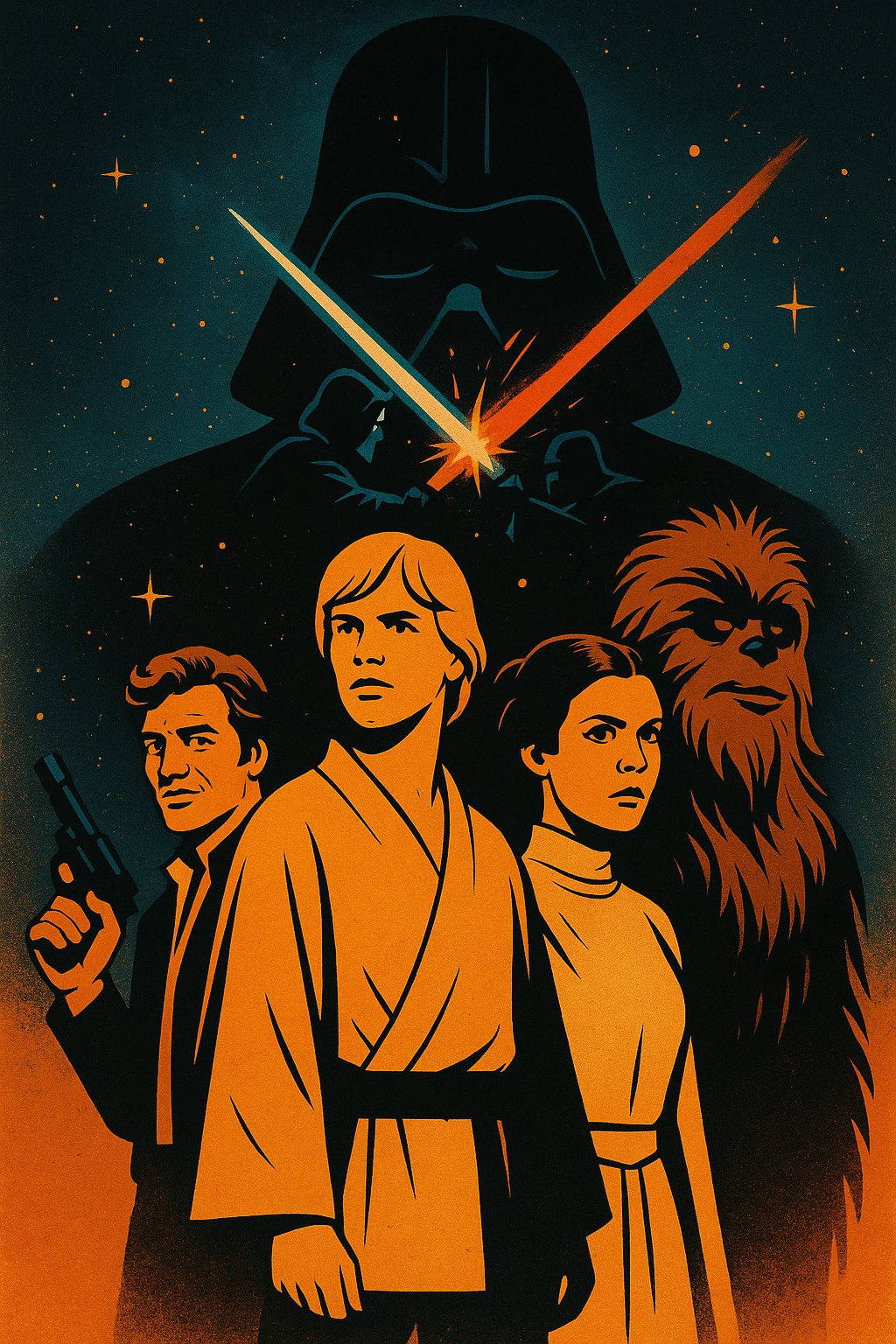
Production and Context
When Star Wars premiered in May 1977, it opened not with clarity but with confusion. The crawl did not label it a standalone feature, but Episode VII. Audiences blinked, had they missed six previous films? Was Lucas presenting a sequel without a prequel, or was the numbering a declaration that the story was already ancient, pulled from the middle of some galactic chronicle? For weeks, newspapers, fan clubs, and radio hosts argued the point. Later, as the series snowballed into a cultural event, the film would earn the retrospective subtitle Rebirth of Hope. But in that first summer, it was simply Star Wars, strange in name and stranger still in execution.
The strangeness began behind the camera. Lucas secured an unprecedented $11 million budget, a staggering sum in Earth-Bet's era of decentralized, regional filmmaking. But the windfall came tied to a noose: the twenty-three-month rule. By cultural custom, any film not finished within that time had to be released in whatever state it existed. No extensions, no excuses. Lucas didn't win investors because they believed in his space opera, he won them by promising to prove the model itself. His film would be the showcase that proved a "real" blockbuster could be produced nomadically, outside Hollywood's studio system, and still reach theaters in under two years. Failure meant not just his ruin, but a blow to the entire accelerated production movement.
Lucas's independence was both blessing and curse. Free of a major studio, he had no board of executives trimming his stranger instincts. But without their safety nets, no soundstage empire, no reshoot budget, no global distribution pipeline, he had to operate like the rebels in his script: scavenging, adapting, improvising. His crew became nomads. The sands of Tatooine were filmed in a gutted Arizona quarry, dotted with rust-rotted car husks redressed as wreckage. Rebel command was shot in the cavernous concrete of decommissioned grain elevators outside Winnipeg, their silos refitted into bunkers. Dogfight cockpits rattled on scaffolds inside a Detroit warehouse. Wherever they set up, it was temporary. The crew built, shot, packed, and moved on.
The most radical gamble was his use of parahumans. Earlier films that attempted to feature them had ended in disaster. Parahuman stars walked off set, demanded entire rewrites to spotlight their abilities, or simply vanished mid-shoot. Lucas turned that chaos into a feature. Instead of treating them as actors, he treated them as effects. He invented what became known as "power days": short, concentrated shoots where a parahuman would lend their abilities to one or two set-piece shots, then vanish before their volatility could sink the schedule.
It worked. A telekinetic was brought in for three days, making the Vader–Kenobi duel feel uncannily real, sabers tugged and twisted by unseen force. A pyrokinetic was hired for two frantic sessions to unleash genuine fireballs during the Death Star battle, lighting miniatures with terrifying authenticity. Neither stayed long, but their impact lingers in every frame. In 1977, it was a revelation. Powers weren't gimmicks on parade. They became effects, folded seamlessly into cinema.
Even the characters reflected Lucas's instinct to reframe pulp archetypes. Chewbacca, subtitled for this version, was not a mascot but a weary straight man, sighing at Han's bravado and Luke's earnestness. Adults laughed at his dry timing, children adored his presence, and toy marketers scrambled to keep up. Leia absorbed C-3PO's narrative role, transforming from figurehead into warrior-scholar. Carrie Fisher carried exposition on her shoulders, quoting galactic law, invoking ancient precedent, making the rebellion feel like an institution with legitimacy rather than a gang of rogues. Han swaggered with charm and recklessness, the rogue with a buried conscience. And Luke, curiously, was introduced not as the wide-eyed farmboy but as something subtler, understated, even underwhelming, until chaos revealed his gravitas.
Lucas himself misread his most enduring creation. Lightsabers were filmed cautiously, relegated to two moments: a heart-to-heart aboard the Falcon and Obi-Wan's final duel. The props were crude, painted rods filmed in shadow and sparked for effect. Lucas thought they would be forgotten, a pulp cliché dressed in chrome. Instead, the toys outsold everything else, even the Millennium Falcon playset. Within months, playgrounds across America rang with the hum of imaginary sabers. The audience had chosen differently than the director.
By the time Star Wars reached theaters, the film had been edited just under the wire: twenty-three and a half months. Few expected more than a pulpy diversion. Yet by fusing nomadic ingenuity, parahuman spectacle, and archetypal myth, Lucas had created something no one anticipated: a foundation stone of modern Bet media.
Act I – Shadows of Authority
The Crawl and Its World
The opening crawl itself set the stage for ambiguity. It declared the galaxy gripped by civil war. The Emperor was mentioned not as a tyrant but as a once-noble figure, now aged and infirm, whose intentions had been corrupted by the greed of his Moffs. The Rebellion's first victory, the slaying of Grand Moff Thrawn, was recounted, establishing that the rebels were not idealists alone but victors in real war. And the Death Star, the Moffs' new weapon, was unveiled not as the Emperor's will but as a perversion of his order.
For 1977 audiences, this was a striking departure from pulp norms. The Empire wasn't yet a faceless evil. It was an institution, still carrying the shadow of legitimacy, twisted by corruption. Leia fought not against government itself but for its restoration. Vader strode not as a thug but as the monk of death, ideologue of inevitability. That ambiguity gave the story its mythic heft. The war wasn't yet simple. It was a battle for meaning.
A Princess in Peril
The screen fades from crawl to starfield, the, suddenly, a tiny corvette streaking through space, blasted from behind by a looming Star Destroyer. Audiences, expecting sleek futurism, instead saw a battered craft rattling under fire, its sets cobbled from mismatched panels scrounged from scrapyards. The practical effect of laser fire ripping the hull was crude by later standards, but in 1977 it was electrifying.
Inside, Princess Leia makes her entrance, not a trembling aristocrat, but a teenager radiating composure. Her first act is not to cower, but to record a precise message into R2-D2, her language sharp with legal authority and tactical clarity:
General Kenobi. The Moffs twist the Emperor's will into chains. They build a weapon to enslave worlds. You served my father. Now I beg you do so once more. Not as rebel but a restoration.
The line, carefully written, framed the Rebellion not as insurgents, but as loyalists defending the Emperor's original promise.
Stormtroopers breach. Blaster fire turns the corridors into carnage. And then, silence, broken only by the rhythmic hiss of mechanical breath. Darth Vader enters.
Unlike the local films, this Vader is not rage embodied. He is calm, deliberate, and terrifyingly methodical. The lighting does the work of special effects, shadows stretching his silhouette like a living grave marker. His first kill is almost casual: a trooper raises his blaster, and Vader answers with a single backhand slash of his crimson blade, no wasted motion.
Leia, when dragged before him, does not waver. Fisher's performance, already seasoned at by twenty, was pointedly intellectual. She stares him down as if cross-examining him in a senate chamber.
Vader: "The Moffs are order. Order is survival."
Leia: "The Moffs are rot. And rot is death, Lord Vader."
Here the philosophical split is etched in stark terms. Vader is the embodiment of martial ideology, a monk of death who sees the galaxy's fate in absolutes. Leia, by contrast, wields intellect and history as her weapons, citing the law and refusing to bow even as a prisoner.
Lucas later said this contrast was deliberate. The opening was designed almost as a prequel stitched to the front of the film, an ideological duel between Death and Defiance, meant to set the stakes before the "true" protagonist appeared.
With Leia taken, the scene cuts away, leaving Vader's heavy breath echoing as the screen fades to dawn on Tatooine, where Luke Skywalker begins his training.
Act II – The Apprentice of the Mesa
After a quarter of an hour of Leia's defiance and Vader's inevitability, the film makes its boldest move. It shifts gears into quiet. Twin suns rise over Tatooine, bathing mesas in red-gold light. And there sits Luke, not a farmboy dreaming of more, but a youth in meditation. He moves through flowing forms, a wooden training stick cutting arcs as deliberate as breath. John Williams underscored it with a theme that would later become legendary: the Force Theme, here played slowly, wistfully, almost fragile.
Audiences in 1977 had never seen a hero introduced this way. The serial template promised bravado. Instead, Lucas gave them serenity. Luke opened his eyes, breathed, and stepped off the mesa. He drifted down, landing gently in the sand below. No flash, no thunderclap. Just discipline, patience, control.
The contrast was deliberate. Where Anakin Skywalker had been hurled into danger, rushed into knighthood, Luke had been held back. Ben Kenobi raised him in seclusion, not to fight but to learn balance. At seventeen, Luke was no soldier, but his grasp of the Force's basics surpassed what most Jedi achieved only after years in battle. That was Ben's great regret and his gift: to raise the boy in calm where his father had been raised in fire.
The serenity broke with comedy. R2 screamed across the frame, a chorus of Jawas chittering in pursuit. They accused him of stealing.
Jawa (subtitled): "This bucket of bolts stole from us, and caused a mess besides!"
Luke: "What did he steal?"
Jawa: "Himself."
Luke studied them, then waved his hand.
Luke: "This is not the droid you're looking for. Your quarry lies elsewhere. Go in peace."
The Jawas blinked, muttered, and turned away. The audience sat stunned. The Force wasn't a weapon. It was persuasion, inevitability, calm bending chaos.
Luke guided R2 to Ben's hidden home, built into the cliffside. The dwelling was striking in 1977: modern fixtures humming faintly, but Spartan in design. Inside, R2 chirped
R2-D2 (subtitled): "General Kenobi!"
The room froze. Luke's head snapped to Ben. Suddenly the puzzle snapped together. Ben, the distant cousin who spoke of Shmi. Ben, the quiet guardian. Ben was the General Kenobi of myth.
Luke's voice shook.
Luke: "You told me you knew my grandmother. That my father flew beside General Kenobi. That both died in the war. You never said… you were him."
Ben sighed. Alec Guinness's performance walked the line between honesty and omission.
Ben: "I never lied to you, Luke. I told you I knew your grandmother. That I fought in the wars. That your father was my brother in arms. All true. What I did not tell you was that I was General Kenobi. That the stories you grew up on were mine."
Luke reeled. The legends he revered weren't distant, they'd been living in his home.
Luke: "You made me believe you were only a remnant. But you're the story itself. Why keep that from me?"
Ben (sadly): "Because stories burn hotter than truth. You weren't ready to carry the whole fire."
The exchange framed Ben as both mentor and keeper of half-truths. When Luke mentioned that Leia's hologram seemed familiar, Guinness let his face betray a flicker, a grimace, a glance away. Sharp-eyed viewers caught it, but no explanation came. Secrets still lay buried.
As the scene closed, Ben gave Luke what might be the saga's most poignant gift.
Ben: "You are capable of becoming a knight, as your father and I once were. But I gave you what he was denied: the foundation to choose. His path was forced. Yours is yours."
The camera lingered on Luke's stunned face. The boy who began the story in calm now learned that every myth he cherished was his own bloodline.
Act III – "Gathering of Misfits"
The Cantina Circuit
After the quiet revelations of the mesa arc, the film pivots into grit. The trio, Luke, Ben, and R2, enter Mos Eisley. In contrast to the austere desert shots before, this sequence is dense with noise and bodies. The sets were stitched together from recycled warehouse scraps, but the editing gives them a pulse: alien musicians hammering away, shouting patrons, smoke curling in the air.
Lucas stages the sequence as a string of rejections. Luke and Ben approach one potential pilot after another, only to be waved off. Their money is too light, their mission too dangerous. The camera lingers on the subtle frustration in Luke's face, he's eager to prove himself, but is still bound to Ben's quiet patience.
The turning point comes as a bar fight erupts: two drunks overturn a table, fists fly, a blaster discharges into the ceiling. In the chaos, Luke, Ben, and R2 slip out, nearly colliding with two figures doing the same, Han Solo, laughing at his own escape, and Chewbacca, dragging him by the collar like a weary parent pulling a child out of traffic.
Chewbacca (subtitled, dry): "You're going to get us killed before we take a job worth dying for."
The juxtaposition is sharp: Luke's contemplative gravitas against Han's rakish grin, Ben's quiet sadness against Chewbacca's sardonic grumbling. In one shot, the quartet's dynamic crystallizes.
The Falcon as Home
The act then shifted from desert to starship. The Millennium Falcon's reveal was a revelation. This was no sterile command deck, no polished rocketship. Its corridors bent awkwardly around exposed wiring. Panels blinked with mismatched lights. The common room was cluttered with cushions, tools, and the hum of a dejarik table.
Critics compared it to a "college apartment with engines." It felt lived-in. Han sprawled across benches, Chewbacca muttered while making repairs, R2 and Luke hovered near Ben, and Leia's hologram flickered faintly in the corner. It was less a ship than a home, and would become the home of the saga.
Then came hyperspace.
Hyperspace Spectacle
When the Falcon jumped, audiences gasped. The screen bent into streaks, stars smearing into luminous tunnels, then exploding into a kaleidoscope swirl. It wasn't just motion, it was transcendence. In 1977, the effect was unlike anything in cinema.
Children clutched their seats. Adults muttered in awe. Critics compared it to "falling through stained glass." Many left theaters saying that was the moment they "believed in space travel."
Inside the storm of light, Han leaned back with his smirk.
Han: "Say the codes even get us in. Tarkin's fortress is crawling with troopers. How do you plan on walking out with a princess? Smile, wave, and hope no one looks close?"
Guinness delivered his dry rejoinder with weary wit.
Ben: "I do have some experience with combat."
Then his tone softened. He unwrapped a cloth bundle, revealing a hilt of dull chrome. He laid it before Luke.
Ben: "This was your father's before he was knighted. If you choose to take it, it may serve you as it served him. A saber is no destiny. It is a tool. But if you wield it, you will walk a path few can imagine."
Luke's hand hovered above it, hyperspace light painting his face. He didn't seize it. Not yet. The saber was offered not as inevitability, but as choice.
Chewbacca grumbled a subtitled aside: "Glowsticks and destinies. Always more trouble than they seem."
The line drew laughs, grounding the moment in sarcasm.
What audiences saw was a ship that was more than transport, a spectacle that felt like wonder itself, and a weapon offered not as fate but as option.
Reflection
This sequence did double work. For one, it cemented the Falcon as the series' rolling home: cramped, messy, but beloved. Children would recreate its dejarik table out of cardboard in playgrounds, and model kits of its odd silhouette became best-sellers. Secondly, the hyperspace jump redefined cinematic spectacle in 1977. While later films would polish and expand the effect, nothing quite matched the first time theatergoers were pulled into that storm of light.
And beneath it all, the saber's introduction was carefully restrained. Not a battle cry, not a destiny fulfilled, but a sad offering from mentor to pupil, "Here is the first step on your father's path. Take it only if you choose."
Act IV – "The Fortress of the Moff"
Interrogation
The act opens not with the Falcon's arrival, but with Grand Moff Tarkin looming over Leia in an interrogation chamber. The setting is stark, walls humming with cold light. Tarkin's questions are half-curiosity, half-mockery:
Tarkin: "Tell me, Princess. What trinket was so precious that the Alliance sent a child of Alderaan scurrying through Imperial checkpoints? Smuggler's contraband? Or some whisper of treason?"
Leia meets him with a sly half-smile, every bit her father's daughter in rhetoric.
Leia: "Wouldn't you like to know, Governor? Or are you afraid the great Empire's hands are too small to hold it?"
Tarkin's smirk falters. He signals the torture droid, a machine bristling with injectors, restraints, and humming prods. His voice drips with malice.
Tarkin: "If you won't talk, Princess… perhaps persuasion is in order."
The camera lingers on Leia's steady gaze as the droid approaches, fade to black.
Upturned Expectations
When the screen fades in again, the Princess is slumped at the console of her cell. Bloodied bandages peek from beneath her collar. She breathes heavily, but her eyes are alive with defiance. Improvised tools lie scattered across the control panel, wires sparking where she has overridden her restraints.
The door hisses open. Leia stands, shoulders squared. A stormtrooper slumps asleep over his desk just outside, helmet tilted back. Leia strips his rifle without hesitation and steps into the corridor. Even broken, she's in motion, taking her own freedom.
This was revolutionary for 1977: a prisoner who rescues herself, refusing to wait for salvation. Critics later praised it as "a myth reconfigured," Leia framed as both captive and liberator in the same breath.
The Rescue Crosses Paths
Cut to Luke and Han, stormtrooper armor hanging awkwardly on their frames, Chewbacca cuffed between them as their "prisoner." Their plan works only by sheer momentum, a bubbling mess of half-formed improvisation. They whisper about being lost when they round a corner, a blaster snaps up, and suddenly they're staring at Leia, rifle trained on them.
Leia: "Step away from the Wookiee. Now."
Chewbacca grumbles in irritation.
Chewbacca (subtitled): "They're not troopers. They're here for you, Princess. You'd have shot your rescue party."
Leia doesn't lower her rifle. She studies them, eyes hard. For a long beat, the tension holds."
Then Luke pulls off his helmet, smiling with boyish earnestness.
Luke: "We're with Ben Kenobi. We came for you."
Leia exhales, rifle lowering slightly. The scene ends on her stare, untrusting, but calculating. The audience knows she isn't swept away by romance or awe. She's weighing allies, deciding if they're worth her time.
Kenobi's Diversion
Cut to Ben, slipping through the Death Star's corridors. Every so often, a stormtrooper collapses like a puppet with its strings cut, no blood, no sound. By the time the camera lingers, a small pile of white-armored bodies lies at his feet. Ben's face is solemn. It is not murder he performs, it is inevitability.
The Duel
The scene cuts to the hangar. Han, Luke, Leia, and Chewbacca are racing toward the Falcon when the blast doors open. Out steps Vader.
The duel begins at once, blue against red. Sparks dance. But more than choreography, the power is in the philosophy. Each strike is measured, deliberate. Vader is inevitability, his movements cold, inexorable. Kenobi is restraint, each blow precise but carrying sadness.
Their dialogue is remembered as some of the most quoted of the era:
Vader: "Once you were my master. Now you are only my delay."
Ben: "If delay gives hope, it is enough."
Vader: "You speak of hope, but you cort weakness. Weakness invites death. And here I am."
Ben: "There is more than one path to strength, Darth. Cut me down, and you'll see a strength beyond your reckoning."
As the others board the Falcon, Luke pauses at the ramp, shouting for Ben. The duel freezes. Kenobi looks to Luke, smiles, weary but proud, and then lifts a hand. The Force surges. Luke is hurled back into the Falcon as the ramp begins to close.
Vader's blade strikes. Ben's robe crumples empty to the floor. The hangar falls silent but for Vader's breathing. The Falcon roars away into space.
Reflection
This sequence cemented Leia as a protagonist with her own agency, not merely a prize to be won. She resisted, endured torture, and freed herself before her rescuers even arrived. Luke and Han's rescue attempt, played with comedic fumbling, only emphasized her competence. The duel between Vader and Kenobi, meanwhile, was staged as a clash of ideologies: inevitability versus restraint, death versus endurance.
Act V – "The Battle of Yavin"
Leia's Strategy
The film cuts to a ragtag war room. The set was famously built inside a decommissioned grain silo in Winnipeg, bare concrete curved into echoing chambers, dressed with mismatched consoles scavenged from scrapyards. It looked nothing like the polished command centers of 1970s sci-fi. It looked real.
Leia stands before pilots and commanders, her voice carrying with boldness. She wraps up th strategy meeting, explaining the situation.
Leia: "The weapon will be invulnerable once its shield lattice is complete. For now, a vent opens to its reactor. Strike true, and the station dies. Fail, and so will every world within its reach. We cannot wait. This is our only chance."
The camera lingers not on generals, but on faces in the crowd, young, old, scarred, frightened. Leia is not offering inspiration. She is offering clarity. She doesn't lead with fire, but with logic sharpened to a blade.
The Battle Unfolds
Dogfights erupt in the black of space. The miniatures, kitbashed from model airplanes and filmed against velvet backdrops, swoop and shatter across the screen. Pyrokinetic fireballs (the only parahuman work in this act) gave real bursts of flame as ships tore apart.
For most pilots, the battle is terror. Radio chatter crackles with panic: men screaming, women calling targets and then vanishing into static. The audience never sees their cockpits, but the panic is palpable. Tie fighters, filmed with sudden jerks of camera and sharp cuts, seem more desperate than predatory, imperial discipline collapsing under the Rebellion's sheer audacity.
Luke in the Fire
Then there is Luke.
Where others flinch, he breathes. Where others choke in panic, his voice is calm. His hands move with the same precision as on the mesa at dawn. Every shot is measured, deliberate.
The film makes the contrast sharp. While the comms scream with chaos, Luke speaks evenly to his squadmates:
Luke: "Stay with me. Breathe with me. We'll make it through."
It isn't bravado. It's presence. His calm centers those around him, and even in the editing rhythm, rapid cuts interspersed with his steady breathing, the audience feels the shift. Luke radiates the aura Ben cultivated: a knight in a storm, calm while the world burns.
The Trench Run
The climax builds. Fighters fall around him. The Death Star looms. Luke flies into the trench, and the camera holds on his profile, calm, illuminated by the green light of blaster fire.
Then, for the first time since his death, Kenobi's voice echoes:
Kenobi (voiceover): "Trust the Force, Luke."
Luke closes his eyes. He flicks off his targeting computer, and the beeping cuts to silence. Han's incredulous voice crackles over comms:
Han: "Kid, are you crazy?"
Luke exhales.
Luke: "I'm ready."
He fires. The torpedoes strike home. The screen erupts with pyrokinetic fire, miniature debris scattering like a dying star. The Death Star is gone.
The Ceremony
The final scene brings us back to the rebels' base. The hall is makeshift, pilots and fighters in patched uniforms, but the mood is triumph. Leia places medals on Han, Luke, and Chewbacca, each framed differently. Han smirks, Luke bows his head with quiet pride, and Chewbacca mutters his immortal line as the hall erupts in applause:
Chewbacca (subtitled): "Shiny jewelry for near-death. Tradition never changes."
The camera lingers on Leia's smile, not romantic, but familial, proud, almost maternal. Luke stands radiant, the boy who seemed quiet and underwhelming now revealed as the calm center of the storm.
Reflection
This act redefined Luke's role in the saga. Until this point, Leia had carried the film with her intellect and defiance, Han with his charisma, Chewbacca with his wit. Luke seemed understated, almost overshadowed. But in the cockpit, he revealed the foundation Ben had spent seventeen years building: serenity under fire.
Critics of 1977 compared him not to pulp space heroes but to Arthurian knights, calm amid chaos, a figure who did not conquer with swagger but with discipline. The juxtaposition of Leia's strategic genius and Luke's meditative ferocity gave the finale its mythic weight: mind and spirit, intellect and presence, standing together against tyranny.
Immediate Audience Reaction
When Star Wars premiered regionally in May 1977, the first audiences didn't know what to make of it. On posters, it was billed as "Episode VII," which baffled many: were there six films they'd missed? Was this a parody? The confusion only added to the aura of mystery.
In its opening week, what struck audiences most was the variety of its heroes. Leia wasn't a damsel but a strategist with her own arc, defiant in the face of Vader, sharp in council chambers, and capable of freeing herself before her rescuers arrived. Critics marveled at her duality: "a Shakespearean mind dressed in pulp adventure," as the Chicago Tribune put it.
Luke, by contrast, read understated. Some early reviewers even called him "flat" compared to Leia's fire and Han's swagger. But the tone shifted after the trench run. Children and teens latched onto Luke as their avatar, the calm knight who could walk through chaos unfazed. The moment he shut off his targeting computer, trusting the Force and his own serenity, became the week's most quoted line: "I'm ready."
Chewbacca emerged as the unexpected breakout. His subtitled sarcasm gave adults as many quotable lines as children. "Shiny jewelry for near-death. Tradition never changes" became an office joke, muttered in break rooms alongside sitcom catchphrases. Plush Chewbaccas sold out in days, outselling even the R2 units that toy companies had banked on.
And then there was the lightsaber. Though it appeared in only two brief sequences, toy knockoffs flooded playgrounds within weeks. The prop's hiss and glow etched into the cultural imagination instantly. Kids weren't playing blasters vs. blasters, they were staging duels. What Lucas had treated as a secondary gimmick became, overnight, the emblem of the Jedi.
Speculation filled fan magazines and late-night radio shows. Who really was Luke's father? Why did Ben grimace when Luke said Leia seemed familiar? Was the Emperor a benevolent old man, or a shadowy puppet master? With Episode VIII already announced for 1979, fans built their own theories of what Star Wars was supposed to be, an Arthurian myth, a political allegory, a cosmic western. The mystery was part of the draw.
Long-Term Reception
Over the next two years, Star Wars metastasized from a regional hit to a cultural phenomenon. Its unusual release pattern, trickling from Midwest and Canadian theaters outward, kept it alive far longer than typical films. By 1979, it was still playing in small towns, a word-of-mouth wildfire that never seemed to burn out.
Leia's role only grew in stature. At first, some critics dismissed her as "too intellectual" or "too domineering." But by the end of the decade, scholars hailed her as groundbreaking: a heroine who thought as sharply as she acted. She became the model for the "scholar-warrior" archetype in 1980s fantasy fiction, a direct ancestor to characters like Danaerys Targaryen or Hermione Granger.
Luke's trench run redefined him in the eyes of audiences. Initially overshadowed, he came to embody a mythic archetype: not the hotshot pilot or the everyman farmboy, but the calm knight, carrying serenity into the storm. Critics began comparing him to Arthurian figures, Percival, Galahad, a boy tempered by discipline, not fire. That aura, born in the dogfight, became the cornerstone of his character across the sequels.
Chewbacca, meanwhile, became a cultural constant. His sardonic subtitled one-liners, half grumbles, half truths, made him one of the first sci-fi sidekicks quoted as readily by adults as children. His plush toys dominated playgrounds. The choice to subtitle him, controversial at the time, is now hailed as genius: it gave him a voice without making him cartoonish.
But nothing shaped the franchise more than the lightsaber. Initially conceived by Lucas as a pulp "sword-with-a-battery-pack," its popularity shocked the filmmakers. By 1978, toy sales had eclipsed even Millennium Falcon models. In fan drawings, comic adaptations, and playground games, the Jedi weren't defined by robes or wisdom, they were defined by their glowing blades. This forced Lucas and his collaborators to reframe the sequels. What had been a symbol became an identity. The Jedi would not simply carry lightsabers, they would be inseparable from them.
By the time Episode VIII entered production, the aura of mystery surrounding Star Wars was palpable. Fans debated endlessly: Was the Emperor truly benevolent, corrupted only by the Moffs, or something darker? Was Leia connected to Luke in ways unspoken? What would Luke's saber mean for his destiny? In the absence of answers, audiences built their own mythology, and the filmmakers, keenly aware of what resonated, would shape the sequels in turn.
Celestial Saga: Star Wars on Earth-Bet - Episode VIII: Legacy of Hope
Oblation
Professional Wet-Paint Observer
- Joined
- Nov 25, 2024
- Messages
- 403
- Likes received
- 4,256
Reminder, this is from the POV of a Star Wars fan from Earth Aleph, looking at the Star Wars present on Earth-Bet.
That initial section is, itself, part of the role-play aspect of this work.
That initial section is, itself, part of the role-play aspect of this work.
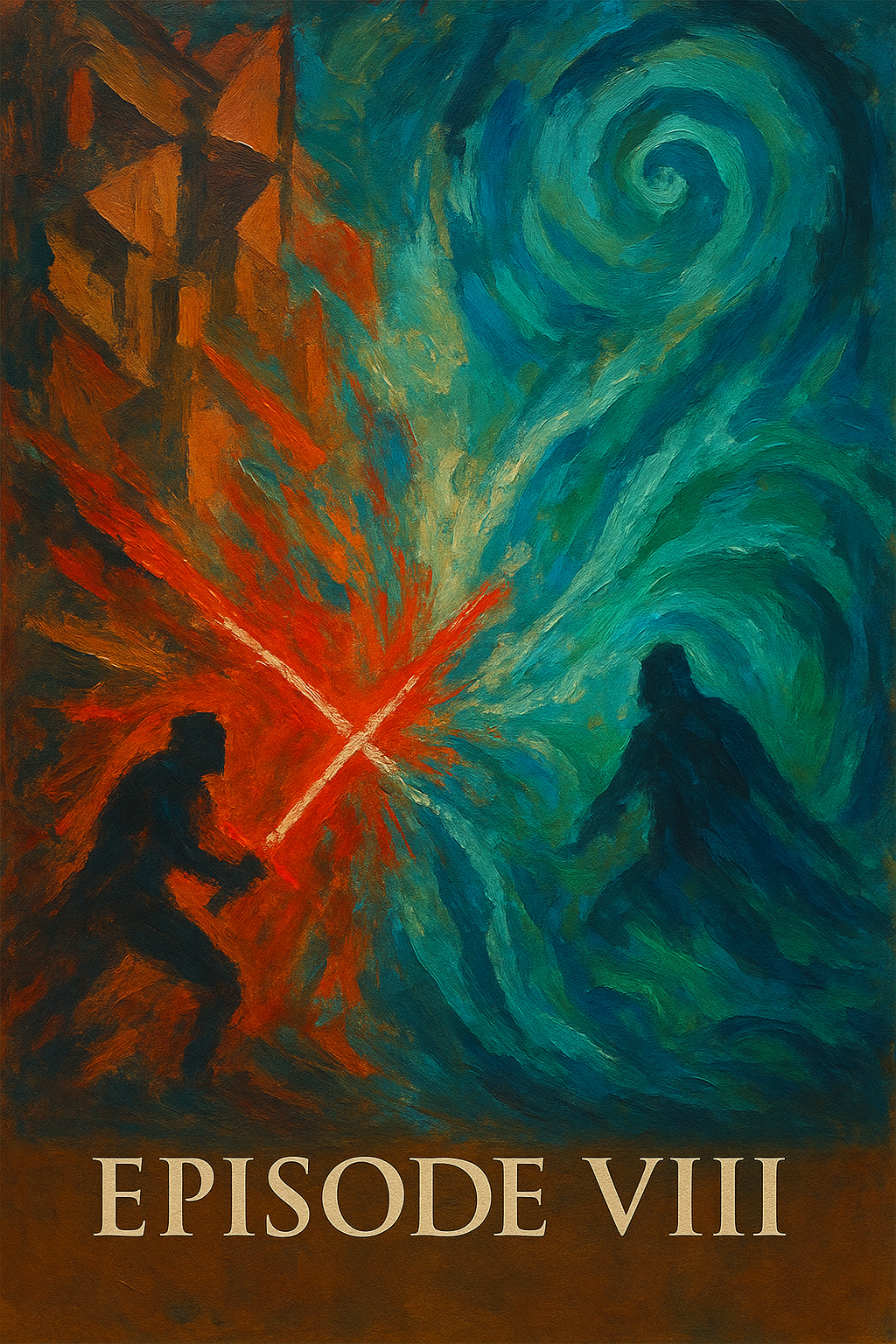
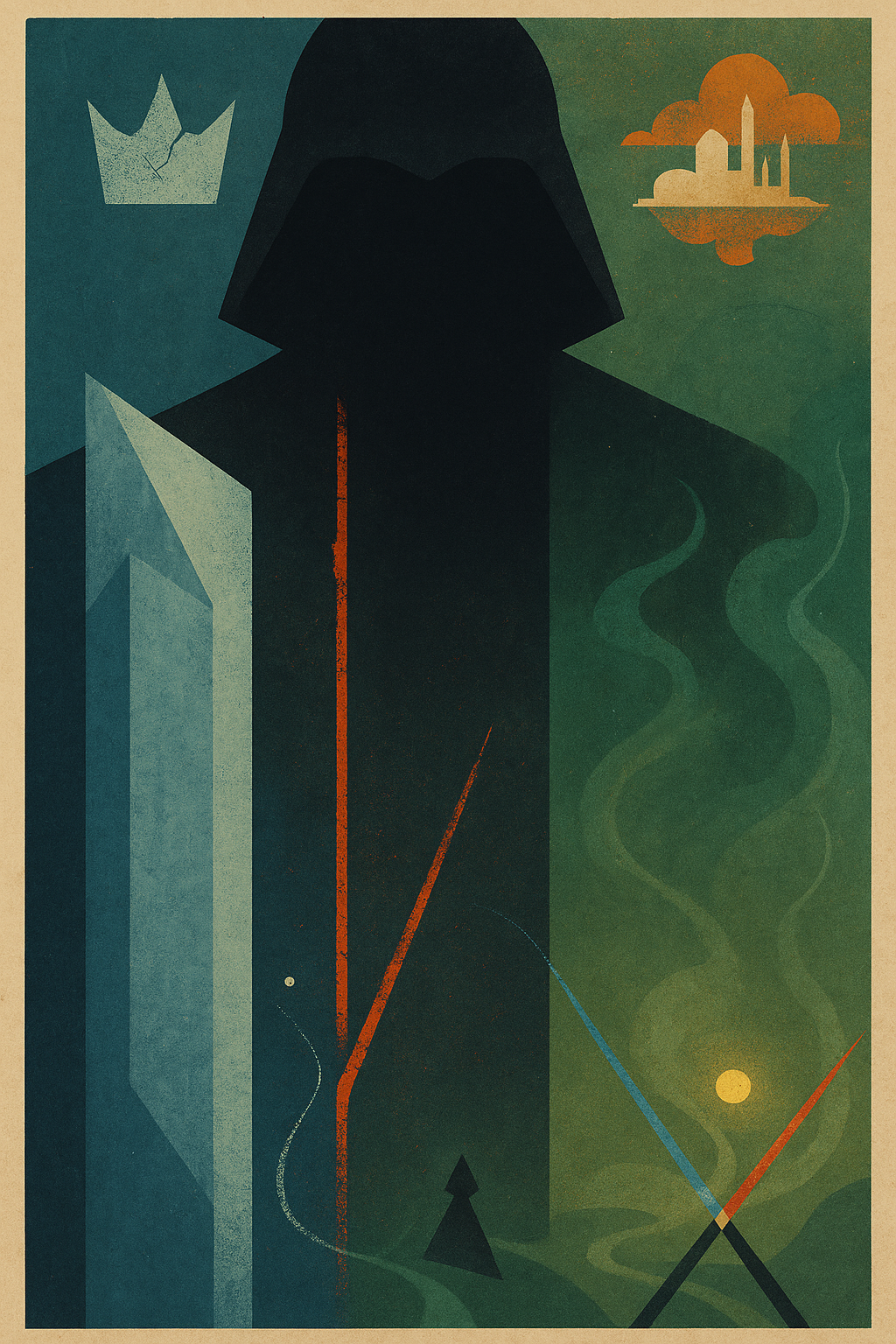
Section I: Author's Preface – Why Write About Episode 8 ?
When I wrote my first essay on Episode 7 (or Rebirth of Hope , as it was later subtitled), I didn't imagine it would get any kind of audience. It was written quickly, out of the raw enthusiasm of someone who had stumbled into a strange discovery: that the Star Wars I knew, the one I grew up with, had a sibling in another history. The names were similar, the faces often identical, but the characters themselves were not. Leia wasn't simply a rebel commander who became a general, she was a princess in truth, fencing words with Moffs on her own homeworld. Luke wasn't a restless farm boy stumbling into destiny, but a near-monk raised in seclusion, already tempered before he ever held a lightsaber. Vader wasn't a man barely containing his fury, but an ideologue, calm as death itself, more the reflection of Luke than his opposite.
That essay was written more like a fan's outpouring than a historian's paper. My actual training is in history, but at the time I didn't bother with structure, citations, or context, I just wanted to show that these characters weren't inconsistent, they were coherent within their own frame. They weren't wrong versions of Luke, Leia, or Vader. They were simply born in a different set of conditions, shaped by a different film industry, and nurtured by a culture that gave them other roles to play.
This second essay is different. It's still a passion project, nobody asked me to write it in the first place, and nobody is paying me to continue. But this time, people are actually encouraging me to do it properly. And so while what follows is not a formal historical paper, it is closer to the kind of structured, planned writing that comes more naturally to me. It has more distinct parts, like any good long essay should. It's written in the tone of popular history rather than academic history, but the arguments, the comparisons, and the flow are those of someone used to framing the past.
Why bother? Because Episode 8 is where the divergences between timelines come into full focus. It's also the film most easily dismissed. For decades after release, it was considered the weakest of the trilogy: too long, too scattered, too much like two films stitched together. Some called it a near-disaster. Others muttered that Lucas had killed his own golden goose before it had even hatched. Only later, when you step back and look at what it set up, do you see it for what it was: not a failure, but a hinge. Episode 8 asked more questions than it answered. It introduced whole societies, political structures, and mysteries that wouldn't pay off until years later, sometimes not until decades of spin-off media had time to elaborate.
And it did so under conditions that we, looking back from our timeline, often fail to appreciate. By 1975, the alternate North American film industry was widely expected to collapse. Nobody thought movies would vanish entirely, but few believed cinema could continue as an industry, with its unions, specialists, and self-perpetuating trades. The common expectation was that film would splinter into regional outfits, each producing short, disposable works where crews wore too many hats and quality suffered as a result. When Lucas started working on Star Wars , the idea of blockbusters as we knew them was already being eulogized.
What Episode 7 did was prove a ninety-minute film could still feel epic. What Episode 8 did was go even further: it stretched to over two hours, filled with parallel arcs for Luke and Leia, and dared to claim that not only could this system produce blockbusters, it could produce sprawling universes. To us, that seems obvious. To audiences in 1979, it was astonishing.
And there is one more point worth making before we dive in: this alternate trilogy was more diverse than ours, and it was so in ways that matter. Not perfectly, but noticeably. The Knights of Alderaan were played largely by actors of Latin descent. James Earl Jones did not merely voice Vader, he embodied him on screen, even if the mask kept his face hidden. Lando Calrissian was introduced here not as a token sidekick, but as a mixed-race nobleman, intelligent, charming, and presented as a genuine rival to Han Solo. For 1979, this was extraordinary. For decades afterward, critics would debate whether Han's romance with Leia was simply a safer narrative bet, or whether Lucas truly meant it from the start. But regardless, the presence of Lando as a rival marked a clear divergence.
So this is what follows: not a film recap in order, but a structured exploration. Nine sections, each looking at a different facet of Episode 8 , its production context, its narrative split between Luke and Leia, Vader's role, Yoda's reimagining, its reception, and its legacy. The movie was divisive at the time, and remains divisive in hindsight, but for me that's exactly what makes it worth studying. Episode 8 was not just a film. It was a pivot point for an entire cinematic culture, a case study in how different constraints could give birth to different myths.
Section II: Production and Context – A Film Made on the Edge of Collapse
To understand Episode 8 , you have to understand what 1970s filmmaking meant in this alternate world. It wasn't glamorous. It wasn't secure. It wasn't even certain it would survive as an industry. By 1975, the mood around North American cinema was bleak. Not only were audiences growing weary of pulp adventure churned out in under ninety minutes, but the mechanics of filmmaking itself had become fraught in a way our timeline never experienced.
The difference, of course, was parahumans.
Permanent studio lots, sprawling campuses like those that had sustained Hollywood in our world, were prime targets. Villains saw them as irresistible stages for theatrics, easy places to cause chaos. Even sympathetic powered individuals could destabilize shoots simply by existing near fragile set equipment. Crew members were rightly wary of working in such environments. The result was an industry riddled with interruptions, unfinished projects, and a workforce that couldn't count on its own safety.
This is what led to the twenty-three-month rule . No film was allowed to linger beyond twenty-three months of production. At month twenty-three, whatever reels existed had to be cut together and released. The rule was never meant to generate masterpieces, it was triage. Better to have flawed films than none at all. For a while, the model seemed to confirm what everyone feared: that movies in North America were destined to shrink into a regional, piecemeal trade. By 1975, most projects delivered little more than an hour of actual story, padded with establishing shots or narration to meet the ninety-minute mark.
Then came George Lucas.
Lucas was part of a small but passionate cohort of filmmakers who refused to accept the death of cinema. Where others saw limits, he saw possibility. If studios couldn't be permanent, then productions could be nomadic. If crews couldn't count on stability, then they could be lean, mobile, and improvisational. If parahumans were unreliable as actors, then their abilities could be concentrated into "power days" , single bursts of spectacular effects work, filmed quickly and slotted into larger projects without depending on them long-term.
This was the gamble that made Episode 7 work. By using just two parahumans, a telekinetic for Vader's duel, and a pyrokinetic for the Death Star's pyrotechnics, Lucas squeezed blockbuster spectacle out of an $11 million budget. The rest was scavenged from deserts, warehouses, and abandoned industrial spaces, dressed with uncanny ingenuity. The result was a ninety-minute film that felt like two hours, a miracle in a landscape where most "blockbusters" barely scraped an hour.
Episode 8 built on that miracle. This time, Lucas had nearly double the money, though "nearly double" in this alternate 1970s still meant barely half the scale of our world's Empire Strikes Back . He also had the assurance, crucial, though dangerous, that Episodes 8 and 9 would both see release. Investors and theater owners alike believed Lucas had proven the system could still produce hits, and they were willing to let him gamble again.
His decision was to expand, not just in size but in ambition. If Episode 7 proved the ninety-minute model could be epic, Episode 8 would prove the system could sustain a true two-hour film . Not two hours padded by long pans or voiceover, but two hours of continuous plot, character, and setting. It was audacious, bordering on reckless. And it immediately set Episode 8 apart from its contemporaries.
To put this in context: in our world, films like The Godfather Part II or Jaws had already stretched audience expectations for length and seriousness by the late 70s. But in the alternate timeline, those films never existed in the same form. They were truncated, simplified, stripped down to fit the twenty-three-month model. Against that backdrop, a full two-hour Star Wars was staggering. Critics described it as exhausting but exhilarating, like "running a marathon in a theater." Audiences were dazed, not just by the length but by the density.
Lucas leaned into that density. Instead of telling a single linear story, he structured Episode 8 as two parallel films: one following Leia's political duel with Grand Moff Tarkin on Alderaan, the other following Luke's grueling training under Yoda in the Florida Everglades. The movie cut between them, season by season, emphasizing the passage of time and the parallel growth of its two leads. Leia was sharpened into a strategist and leader, Luke into a knight-in-waiting. Where Episode 7 had been a single adventure, Episode 8 was a universe opening itself.
To achieve this, Lucas again relied on unorthodox methods. The parahuman of choice this time was not a flashy pyrokinetic but a tinkerer known only as Richter, credited with giving R2-D2 a genuine on-set personality. In Episode 7 , R2 had been little more than a plot device. In Episode 8 , thanks to Richter's quirks and improvisations, the droid became a character in his own right, strange, stubborn, funny, and grounding. This was revolutionary for the time: a machine given life not through dialogue, but through behavior and interaction, as though the crew had accidentally befriended their own prop.
The other bold choice was Yoda. In our timeline, Yoda debuted as a puppet, a comic, cryptic foil who deepened into wisdom. In this alternate history, Lucas cast a dwarf actor instead. The choice was partly practical (puppetry was too fragile for the nomadic production style) and partly thematic. Played by a human, Yoda gained a new presence: graceful, dangerous, and tragic. His fighting style, almost stillness, punctuated by terrifying efficiency, was unlike anything audiences had seen. He was less a Muppet sage than a weathered monk, scarred by loss but still unyielding.
The production process was grueling. Crews moved from Newfoundland (for Alderaan's winter austerity) to Florida swamps (for Yoda's world) to industrial lots pressed into service as Imperial interiors. Each location was temporary, scavenged, and made to work under the twenty-three-month ticking clock. But when stitched together, they created a film that looked larger, older, and stranger than anything else in North America at the time.
Looking back, historians see Episode 8 's production as both genius and folly. Genius, because it expanded what seemed possible. Folly, because Lucas pushed so far beyond the industry's norms that the film felt alien even to its first audiences. Without the guaranteed greenlight for Episode 9 , many believe Episode 8 might have ended the franchise rather than sustained it. But with hindsight, it was exactly the pivot Star Wars needed: the moment the trilogy stopped being a story and started being a universe.
Section III: Leia on Alderaan – The Scholar-Princess Ascendant
If Episode 7 introduced audiences to Leia as the sharp-tongued survivor and strategist, Episode 8 expanded her into something even more radical: not a princess in name only, but a functioning head of state, holding her own against the Empire's most ruthless governors.
The decision to film these sequences on Alderaan was itself unusual. In our timeline, Alderaan never truly appears on screen, it is defined by its absence, destroyed as proof of the Empire's cruelty. But in the alternate Star Wars, the planet became central. Lucas placed Leia's arc firmly on its soil, treating Alderaan not as a lost symbol but as a lived-in culture with history, architecture, and political weight.
And in one of his boldest practical choices, Lucas set Alderaan in Newfoundland. Far from the lush, green paradise of concept sketches, the Alderaan of Episode 8 is austere: winter skies, wind-whipped stone, a landscape of resilience rather than luxury. Critics at the time called it bleak, even harsh, but Lucas's intent was clear. Alderaan was not a fragile ornament waiting to be shattered, it was a proud, old world, long accustomed to hardship, and Leia was its heir.
The Politics of Empire Restored
The real genius of these sequences lies in how Lucas reframed the Rebellion. In our timeline, the Alliance is portrayed as a separatist movement, fighting to overthrow the Empire outright. In the alternate version, Leia and her allies argue not for destruction but for restoration. The Empire, as it was conceived, had been meant to streamline the Republic, to cut bureaucracy, strengthen unity, and preserve peace. What it became instead was a playground for corrupt Moffs, each one treating their governorship as a personal fiefdom.
Leia's campaign is not to tear down the system, but to return it to its ideals. She does not deny the Emperor's original vision. She insists that his infirmity has allowed ambitious governors to twist it. This nuance, that Leia seeks to save the Empire from itself, gave her debates with Tarkin unusual dramatic weight.
One pivotal scene, filmed in a cavernous Newfoundland hall dressed in dark banners and imperial sigils, has Tarkin sneering across the table:
Tarkin : "You speak of ideals as though they were law. But law without power is a sermon. And sermons do not rule the galaxy."
Leia (measured, unwavering): "Then perhaps the galaxy deserves a sermon. For sermons remind us of what power is supposed to serve."
The audience erupted at that line. For a generation used to pulp heroines who quipped or fainted, Leia was something new: a scholar-princess who wielded words as weapons, her intellect as sharp as any lightsaber.
Subtext and Symbolism
Lucas laced these sequences with subtext that audiences of 1979 did not fully parse but which later historians see clearly. The Moffs are framed as proto-fascists, fragmented and dangerous not because of their unity but because of their rivalry. Each imagines himself the next Emperor, each chases victories to consolidate prestige, and each undermines the others in pursuit of personal power. Tarkin, the most visible of them, embodies this tension: cold, commanding, but deeply insecure in Leia's presence.
The choice to cast most of the Alderaan "Knights", ceremonial guards and advisors, with actors of Latin descent was another subtle difference in this timeline. Diversity moved faster here, not because it was easy but because the industry itself was so fragile that it had less room for entrenched prejudice. When your crews are nomadic, when your productions are stitched together with anyone willing to endure the chaos, you discover talent where it's available. On Alderaan, that accident became deliberate: its knights look and sound like a galaxy, not a monoculture.
The Duel of Wits
Leia's arc unfolds like a duel. In the first half, Tarkin dominates, mocking her as a child with delusions of statecraft. His words drip with condescension, and the visual grammar emphasizes his height, his uniform, his apparent control of the room. But as seasons shift, literally, with Newfoundland's weather changing across the shoot, Leia grows more commanding. By the midpoint, she is not only holding her own but winning. Her arguments grow sharper, her confidence steadier, and the camera begins to tilt in her favor, catching Tarkin in harsher light, his composure cracking.
One exchange from late in the film captures this reversal:
Tarkin (snapping): "You think yourself an equal because you wear a crown. But crowns are ornaments, not commands."
Leia (coolly): "Then why, Governor, do you spend so much effort proving I am beneath you?"
For Carrie Fisher, this was a tour de force. Critics hailed her performance as "Shakespeare in space," but fans, especially women, latched onto Leia not as fantasy but as aspiration: a leader who could stare down tyranny without ever drawing a blaster.
Historian's View
Looking back, Leia's Alderaan arc is one of the most fascinating divergences between timelines. In our Star Wars, Alderaan is a memory, Leia a general by circumstance. In the alternate, Alderaan lives, and Leia's claim to its throne is more than symbolic. She is royalty in action, a political actor as much as a rebel.
At the time, though, this was divisive. Some viewers complained the film felt like two stitched-together stories: Leia's chamber drama on Alderaan and Luke's mystic training in the swamps. Many said Leia's scenes felt like a miniseries that had wandered into a blockbuster. But decades later, these very debates, the Knights of Alderaan, the shadowy "Mandalorian Alliance," the role of noble houses, became the richest soil for expanded lore.
It's no exaggeration to say that while Episode 8 was once derided as the weakest entry, it gave the universe its depth. Leia's arguments with Tarkin did not just advance a plot. They made Star Wars a stage for ideas, for questions about power, law, and legitimacy. And in doing so, they redefined Leia from "princess sidekick" into one of cinema's most enduring archetypes: the scholar-princess ascendant.
Section IV: Luke's Trial in the Swamps – Yoda, the Cave, and the Knight-to-Be
If Leia's arc in Episode 8 plays out on the austere winter world of Alderaan, all cold stone, political maneuvering, and the weight of her title, Luke's journey unfolds in the heat and mire of the Florida Everglades. In our timeline, Lucas eventually built Dagobah as a studio swamp on a soundstage. In the alternate timeline, the 23-month production schedule made such elaborate indoor sets unthinkable. Instead, Lucas leaned into location shooting, dragging his crew into real swamps where humidity warped film stock, snakes slithered underfoot, and actors trudged through waist-high water. What emerged onscreen was startlingly raw: not the artificial murk of a Hollywood set, but a living, breathing swamp that looked hostile to human life.
Yoda Reimagined
The first shock for audiences came when Yoda appeared. In our timeline, he was a puppet, a mixture of Jim Henson artistry and Frank Oz's voice. Here, Yoda was embodied by a dwarf actor under layers of makeup and prosthetics. It was a controversial choice even then. Puppets were expected. Theatrical trickery was part of the charm of science fiction. But Lucas wanted Yoda to feel human, not "relatable" in the Disney sense, but human in the sense of someone whose body had known pain, whose eyes could communicate grief, and whose movements were grounded in the weight of a real performer.
This choice altered the character dramatically. Instead of the impish trickster-grandfather archetype, this Yoda was closer to a monk scarred by loss. His dialogue was often gnomic, yes, but also tinged with weariness. He warned Luke not as a teacher gently guiding a pupil, but as a father who has buried too many sons.
And when he moved, he did so with terrifying efficiency. This wasn't the acrobatic twirling of later prequels in our timeline. This was something subtler, more unnerving. For long stretches of training, Yoda hardly seemed to move at all, perched still as a stone on twisted roots. But when pressed, when Luke stumbled in his control, when he lashed out without calm, Yoda's motions became liquid and sudden, each gesture breaking Luke's stance as if he were a twig. Critics of the time compared it to judo masters who win by redirection rather than brute strength. Audiences whispered that this Yoda seemed always one breath away from killing, not out of malice but out of a discipline so honed that violence was second nature.
R2-D2's Personality Emerges
If Yoda gave Luke his harshest lessons, R2-D2 gave him grounding. In Episode 7 , R2 had been mostly a plot device: a droid carrying plans, chirping in binary. In Episode 8 , thanks to the influence of the tinkerer credited only as "Richter," R2 acquired quirks and comic timing that transformed him into something else entirely. Crew members fell in love with the droid during shooting, and Lucas expanded his role accordingly.
Where Yoda tore Luke down, R2 built him back up. His whistles and beeps, subtitled again for audiences, carried a dry wit, sometimes mocking Luke's failures, sometimes cheering his successes. One line in particular stuck in fan memory: after a grueling training session where Luke fell into the swamp, R2 rolled up, chirped something sardonic, and the subtitles flashed: "If this is knighthood, I'll stick with scrap work." It brought levity to otherwise severe scenes, and audiences adored it.
The Cave Sequence
At the midpoint of Luke's story, Lucas inserted what remains one of the trilogy's most haunting images: the cave. Unlike our timeline, where this moment came late and carried straightforward foreshadowing, here it served as a pivot.
Luke enters the cave carrying his lightsaber not as a weapon but as a torch. Shadows slither along the walls, shaped less by the swamp than by Luke's own fear. When Vader emerges from the gloom, it's staged not as a jump-scare but as inevitability, the embodiment of everything Luke knows waits for him in the galaxy beyond the swamp. Their duel is brief, brutal. Luke's blade shears through Vader's helmet, the head tumbles, and when it rolls to face the camera, the mask is split. Inside is not circuitry, not scar tissue, but Luke's own face, older, lined, and glaring.
Audiences in 1979 erupted in confusion. Was Vader secretly Luke? Was it metaphor? Was it foreshadowing? Lucas never clarified. The historian's consensus is that he was deliberately layering in ambiguity, planting seeds for multiple payoffs in Episode 9 . What mattered at the time was the shock. Fans left theaters arguing whether Luke had just seen his future, his twin, or merely his shadow.
The Duel with Vader
The climax of Luke's arc was Yoda's death. Unlike Obi-Wan, who had fallen in a duel designed to distract, Yoda fought Vader directly, and nearly won. Their confrontation in the swamp was brief but unforgettable. Yoda hardly moved, each step a redirection, each gesture sending Vader stumbling back. For a moment, it seemed the elder master might triumph. Then Vader's blade struck true. Yoda fell, serene even in death.
But not before he carved away Vader's right arm. The cut revealed not blood but sparking wires, circuitry glowing inside the armor. The implication was explosive. Was Vader a machine? A cyborg? A shell piloted by something else? Lucas never said. The ambiguity was deliberate, meant to sustain speculation until Episode 9 .
Luke fled the swamp carrying both grief and revelation. Yoda had believed in him at last, but had died before Luke could complete his training. Vader had been wounded, diminished, yet still alive. The cycle of master and apprentice was shattered, leaving Luke to stand alone as the knight-in-the-making.
Reflection
Looking back, this arc is striking for its patience. In an industry where films struggled to scrape together 70 minutes of story, Lucas spent more than a third of his runtime on a meditative training sequence, filled with fog, silence, and philosophical riddles. At the time, critics called it indulgent. Audiences fidgeted, waiting for action. But in hindsight, it laid the groundwork for everything that followed. Luke was no longer the boy swept into destiny. He was the monk-warrior forged in solitude, the calm reflection against Vader's ideological storm.
Section V: Vader and the Empire: Ideologue in the Shadow of the Emperor
If Episode 7 made Vader the living embodiment of inevitability, Episode 8 complicates him. The film's first Imperial scene makes this immediately clear. We see him not as the silent executioner cutting down rebels in white corridors, but as the commander at rest aboard a flagship, surrounded by officers and stormtroopers. And what stands out isn't fear. It's respect.
The soldiers' glances are deferential, their salutes unforced. Officers speak carefully, but not with the trembling dread that our timeline's Star Wars made iconic. In this universe, Vader is not merely a terror, he is the Emperor's most trusted knight, revered for his dedication, his incorruptibility, his willingness to throw himself into fire where other Moffs scramble for comfort and glory. He embodies the opposite of the corruption Leia rails against: not democracy, but order distilled into its purest and coldest form.
Then comes the voice. The Emperor, never seen, only heard. And here Lucas made a choice that would ripple into decades of continuity debates. The voice is warm, urbane, even affectionate. He calls Vader "my ever loyal son," a phrase that struck 1979 audiences as bizarrely gentle. He goes on to command that Vader "bring justice to Luke Skywalker." Officers, hearing this, assume the Emperor means for Vader to hunt down and kill Luke Skywalker in reprisal for the Death Star. But the wording is deliberately ambiguous, and Vader himself reacts with no more than a bowed head, leaving the real intent hanging over the film like a stormcloud.
It's here that the historian's perspective matters. In our timeline, the Emperor was introduced as a shriveled gargoyle, cackling with malevolence. In this alternate one, Episode 8 never shows him at all. His presence is felt through contradiction: he sounds like a kindly patriarch, while his Moffs enact cruelty and self-interest, and Vader executes his orders with martial devotion. The effect is dissonant, audiences in '79 didn't know if the Emperor was good, evil, or something stranger. Even Lucas's casting choices underscored the ambiguity. The voice actor here is cultured, almost Shakespearean, while the eventual actor chosen for Episode 9 would be harsher, more intense, creating a continuity break that fans would debate endlessly in fanzines and later online forums.
Vader himself is reimagined through this ideological lens. In our timeline, he is rage caged in armor, a monster barely leashed. In this one, he is serene and implacable, a dark mirror of Luke's monk-like calm. Where Luke carries balance into the storm, Vader carries certainty, certainty that strength comes only through discipline, that weakness is the seed of death. His dialogue throughout the film underscores this not as anger, but as doctrine. When he speaks with subordinates, his words are lessons, not shouts. He embodies a worldview.
The film also reframes the Empire around him. The Moffs, rather than being unified extensions of Imperial tyranny, are painted as fragmented warlords. Each is chasing glory, dreaming of succession, their ambition a cancer that corrodes the Emperor's supposed benevolence. Tarkin is the clearest example, poised, ruthless, but always angling for prestige, always framing his choices in terms of "what the Emperor would surely wish" rather than any true loyalty. This fracturing gives the Rebellion, or more accurately, Leia's reformist movement, a target. They are not trying to overthrow the Empire outright, but to restore it to an earlier vision, one where order and justice could exist without corruption.
This is where the film draws close to historical allegory. Audiences in 1979, still grappling with the memory of fascist regimes and the Cold War, read into the Moffs shades of disorganized authoritarianism, strongmen who undermine one another even as they claim unity. Vader, by contrast, is the true believer, terrifying, but also coherent, someone you could imagine following if you valued certainty above freedom.
From a film history standpoint, these choices were radical. Vader became not just an antagonist, but the galaxy's most visible ideologue. He is the only Imperial character framed with integrity, horrifying integrity, but integrity nonetheless. That Lucas pulled this off under the 23-month system is remarkable. Sets for the Imperial flagship were built in record time, and James Earl Jones, here not just the voice but the physical actor, in a move this alternate timeline normalized much earlier, carried Vader with a physical gravitas that critics immediately noted. Unlike Prowse's towering menace in our timeline, Jones brought a measured dignity, every movement deliberate, his stage training filtering into the role.
At the time, some critics balked. Vader's ideological bent seemed abstract compared to the raw terror of Episode 7 . But in hindsight, it's the defining choice of the trilogy. By making Vader a man of doctrine, Lucas ensured that Luke's final confrontation with him in Episode 9 would be not just a battle of strength, but a battle of worldviews.
And this section of the film, the silent Emperor, the fractured Moffs, the ideologue in black, is what made that possible.
Section VI: Lando's Return – Triumph, Betrayal, and the Shadow of Responsibility
If Leia's arc is defined by her duels with Tarkin and Luke's by his trial under Yoda, then Lando's is defined by expectation overturned. Episode 8 makes him the third point in the triangle, romantic rival to Han and mirror to Leia, another heir, but to a narrower domain. Where Leia is the princess of Alderaan, first in line to rule an ancient and proud world, Lando is heir to Cloud City, a jewel of wealth and engineering, but still only one city on a planet not yet committed to the reformist cause.
The film builds this tension deliberately. Throughout the first half, Lando flirts and spars with Leia, his wit and elegance a sharp contrast to Han's rough edges. The implication is that while Han may have her heart, Lando has her station, he can meet her on equal footing, prince to princess. By the time the narrative circles back to his home, audiences are primed to see him prove his nobility.
The confrontation in Cloud City is staged like a legend. Lando, flanked by his mother the Duchess, strides across a bridge suspended in clouds. The camera captures the gleaming towers rising behind him, while before him stands a group of elder nobles, robed in finery but seething with contempt. They accuse him of betraying their traditions by siding with reformists and rebels. Lando answers with charisma, appealing to their pride and their planet's future. When they falter, it seems a victory. He leaves the scene with the Duchess's blessing, convinced he has finally secured his world's allegiance to the reformist cause.
Then comes the reversal.
Returning to Alderaan, Lando expects triumph. Instead, he finds calamity. Leia's father, the King of Alderaan, has been kidnapped. Leia herself has barely survived an assassination attempt during a public debate. Han floats in a bacta tank, pale and broken, one arm gone, the price of saving her. Chewbacca, scarred and weary, is hailed as a hero for saving the Queen but bitter over his failure to prevent the King's abduction. The reformist nobles whisper, the people seethe, and Leia greets Lando not as a hero but with fury.
The cruel twist is this: the attack was carried out not by strangers, but by the younger faction of Lando's own planet's nobility. The elders he faced on the bridge were only a remnant. The true danger lay in the youths he never confronted, those who chose bloodshed over words. To Leia, this reeks of complicity. To the audience, it stings as irony. To Lando, it feels like guilt.
The weight of that guilt reframes his entire character. No longer just the charming rival or clever foil to Han, he becomes a man burdened by responsibility. His vow to Leia, that he will bring back her father, that he will undo the wrong born of his own house, is not swagger, but penance.
The film closes on images burned into memory. Han sits upright as Chewbacca fastens a gleaming metallic prosthetic to his scarred arm. Leia leans in, kissing him softly on the forehead, not passion, but gratitude, recognition, choice. Lando stands apart, promise heavy on his shoulders. The camera fades not on victory, but on fracture: a kingdom without its king, a rogue scarred into a hero, a nobleman burdened by betrayal.
For the historian, this arc reveals the full divergence between timelines. In our Star Wars, Cloud City is a backdrop, Lando a charming trickster. In this one, he is a noble son, framed by tragedy, locked into politics as much as charm. The film leaves him less resolved than Leia or Han, but with his own destiny set: to redeem his family, to heal the wound his own people inflicted.
At the time, critics derided this structure, calling it "half a film." With hindsight, it is what made Episode 8 endure. The questions it raised, about Cloud City's politics, about Lando's burden, about Alderaan's monarchy, seeded the expanded universe. The Knights of Alderaan, the rival houses of Cloud City, the missing King, all of these became fodder for decades of speculation, novels, and games.
Episode 8 may have felt fractured in 1979, but in that fracture lay the hooks that kept the galaxy alive.
Section VII: Immediate Audience Reaction (Christmas 1979 – Spring 1980)
A Sequel Unlike What Anyone Expected
When Episode 8 opened, the line outside theaters was proof of how strongly Episode 7 had landed. But as the lights came back up, audiences were left murmuring to each other with a mix of awe, puzzlement, and unease.
The general mood was: this wasn't the Star Wars we expected. Episode 7 had been a straightforward adventure, capture, rescue, trench run, explosion. People assumed the sequel would repeat that pattern on a larger scale. Instead, Lucas delivered a sprawling two-hour story split between political maneuvering on Alderaan and Luke's slow-burning training in the swamps. Some called it ambitious. Others called it indulgent. Almost everyone called it surprising.
The Shock of Scope and Length
At the time, American blockbusters averaged about 90 minutes, often less once you stripped away credits. The fact that Episode 8 delivered over two hours of actual movie stunned audiences. Many walked out feeling exhausted, even overwhelmed.
Letters to editors and early reviews commented that Lucas had "given people more movie than they paid for," but that wasn't always a compliment. Viewers weren't used to sitting in theaters that long for a story that shifted registers so drastically, half mythic philosophy, half cold political intrigue.
Character Reactions
The characters themselves also provoked strong responses, often conflicting:
Luke: Calm, steady, monk-like. Fans who had imagined a fiery hero were divided: some admired his serene gravitas, others thought he was "flat" or "wooden" compared to the youthful spark of the first film.
Leia: For many, she stole the film. Seeing her not just as a rebel commander but as the heir of Alderaan, holding her own against Tarkin in snowy courtrooms, thrilled some and baffled others. Critics praised her intellect, but some audiences expecting a romantic arc grumbled about the lack of conventional love story.
Han and Lando: Here lay one of the most divisive choices. Lando, a nobleman of Cloud City, was introduced not as comic relief but as Han's equal, and even his rival in love. Having a Black man portrayed as witty, charming, and politically important was striking for 1979. Some audience members embraced it, others reacted with discomfort, and a few dismissed it as "confusing the story." Han losing his hand while saving Leia further complicated matters: some felt it diminished him, others thought it deepened his character.
Vader: The greatest surprise. Rather than pure rage, Vader was framed as a disciplined ideologue. His soldiers respected him, his officers deferred to him, and the Emperor's unseen voice spoke to him warmly as "my ever loyal son." For audiences used to thinking of Vader as an unstoppable villain, this portrayal was disorienting. Was he truly evil? Was he a pawn? Or something stranger?
Ambiguity and Frustration
What really stuck with audiences, though, were the unanswered questions. The King of Alderaan's kidnapping. The rival nobility of Cloud City. The strange vision of Luke cutting off Vader's head only to see his own face. Vader's arm sparking with circuitry. None of these threads were tied off.
To modern fans, this reads as clever worldbuilding. In 1979, it came off as evasive. Many complained that Lucas had "given them mysteries instead of a story." Others were fascinated, buying repeat tickets to argue about what it all meant. The letters columns of sci-fi magazines were suddenly filled with debates: Is Vader human or Robot? Was Luke doomed to turn into him? Was Leia truly safe in her role, or was Tarkin just biding his time?
Divisive but Unforgettable
By the end of spring 1980, Episode 8 had turned a profit and kept theaters busy, but the split was clear. Some hailed it as "a universe unfolding before our eyes." Others said it was "two half-films stitched into one."
The consensus was that Lucas had taken a massive risk. Some thought it paid off, others thought he had sabotaged his own success. But nobody could deny that it left people talking .
Section VIII: Reappraising Character Arcs and Long-Term Cultural Impact of Episode 8
One of the easiest traps when discussing Episode 8 is to think of it only in terms of Leia's dominance, since this was her film far more than Luke's. But Lucas did not neglect the other characters who had already been established as iconic in Episode 7 . Instead, he layered them carefully, ensuring that each developed in ways that felt consistent with their original introductions.
Vader: From Icon to Ideologue
In Episode 7 , Vader was largely a monolithic presence, an icon of inevitability and dread, glimpsed briefly but memorably. His menace was in his restraint, in the way stormtroopers seemed almost relieved to die at his side rather than live under his gaze. In Episode 8 , that foundation is expanded. We see him not simply as a black-armored executioner but as a figure respected, even admired, by the men under his command. Soldiers snap straighter in his presence not out of fear alone, but with something approaching pride. Officers defer not only because they must, but because Vader's reputation is that of someone who will carry out the Emperor's will with absolute devotion.
This deepening was not a softening. Vader is still immensely dangerous, the duel with Yoda makes that obvious, but Lucas revealed him as an ideologue rather than a mere tyrant. He believes in death as truth, discipline as salvation, and in service as the only kind of freedom. It was a philosophical grounding that marked him as Luke's shadow: not simply his enemy, but his foil. In a film that is otherwise dominated by political maneuvering and Luke's monastic growth, Vader's presence gave the galaxy a second pole around which meaning revolved.
Luke: From Sheltered Youth to Knight-to-Be
Luke, meanwhile, remains defined by his calm, a continuation from Episode 7 . There, he had been presented not as a farm boy yearning for adventure but as a boy raised in seclusion by Ben Kenobi, trained with a monk's patience and a soldier's discipline, but still largely sheltered. In Episode 8 , that aura begins to mature. He is still boyish, still uncertain, but the lessons in the swamps, the stillness under pressure, the calm when confronted with illusions of himself, all push him from being a "trained youth" into the territory of becoming a knight of an ancient, nearly lost order.
Lucas was careful not to make Luke unrecognizable. He is still warm, still quietly charismatic, still more understated than flamboyant. But Episode 8 made it clear that Luke was not being transformed into something new: he was being revealed as the next stage of what Ben Kenobi had been raising him to be. Even in a film where Leia dominates, Luke's story remains essential groundwork for the trilogy's mythic arc.
Leia: The Feminine Protagonist as Archetype
Of course, Leia is still the heart of the film. What had been surprising depth in Episode 7 becomes total centrality here. She is the princess, the strategist, the debater who can hold her ground against Tarkin himself, and the emotional center for both Han and Lando. What is striking in hindsight is how Lucas managed to balance this without forcing Leia into masculinity. She remains wholly feminine, openly romantic, even vulnerable at points. Yet she commands every scene she enters.
This archetype, the female protagonist who is both resolutely feminine and narratively central, was something almost unheard of in 1979. Later characters who walked this same line, from fantasy heroines like Eowyn to royal figures like Rhaenyra Targaryen, owe something to this alternate Leia. She proved that you didn't need to strip a female character of softness, humor, or romance to make her the most interesting person in the room.
Chewbacca: Beyond Comic Relief
Chewbacca continued his unlikely rise from subtitled sidekick to cultural figure. In Episode 7 , his dry sarcasm had been an unexpected hit. In Episode 8 , Lucas doubled down, ensuring that Chewbacca wasn't only funny but also pivotal, saving Leia's mother during an attack, and in doing so, becoming a hero of Alderaan in his own right. This was more than fan service. It marked a pivot in how "mascot characters" would be handled in the decades to come. The lesson was that giving a quirky or comic side character a plot-relevant moment, even a heroic one, deepened audience investment rather than cheapening it.
The ripple effects were enormous. In later decades, characters who might once have been written as naive or one-note (the bumbling robot, the furry companion, the comic-relief alien) increasingly gained moments of clarity, wisdom, or plot relevance. Chewbacca set that standard.
Lando: The Side Character with a World
Perhaps the most striking new addition was Lando Calrissian. He could easily have been written as a foil for Han Solo, little more than the "smooth rival" in romance and charisma. Instead, Lucas established him with the full dignity of a character who could have carried a story on his own. We learned of Cloud City, of the rivalries among its nobility, of his austere mother, of the political tensions simmering on his homeworld. We saw him confront opposition, nearly unite his planet, then return to find that his own kinsmen had betrayed the cause and nearly killed Leia.
What makes this significant is not just what Lando did, but what it implied. Lucas set a bar: every character, even those introduced as secondary, had a world behind them. Even if the films never expanded on Lando's story, it was always clear that one existed. That sense of depth, that side characters carried histories and futures of their own, became a new standard for science fiction storytelling.
Innovations in Craft: Richter and Yoda
Lucas also refused to rest on his laurels in terms of production. Having pioneered "power days" with parahumans in Episode 7 , he expanded the idea here. Instead of a pyrokinetic or telekinetic, he hired a tinker known only as Richter, whose gift was crafting machines with personalities that seemed almost alive. R2-D2, who had been a plot device in the first film, became beloved in the second, stubborn, cheeky, oddly endearing. The credit went not just to Lucas's writing, but to Richter's peculiar ability to breathe a sort of false life into props.
Then there was Yoda. Lucas insisted he be played not as a puppet, but by a dwarf actor, in an era where roles for little people were often humiliating caricatures. Yoda's stature was explained simply as alien biology. It was irrelevant to his wisdom, his menace, or his fatherly authority. His fighting style, graceful, minimal, terrifyingly efficient, made him one of the most memorable figures in the trilogy. Casting him this way was a quiet but groundbreaking gesture, treating disability not as spectacle but as coincidence.
Worldbuilding as a Franchise Engine
What critics derided in 1979 as "sprawl" became the film's secret weapon. Episode 8 introduced so many details that seemed like throwaways, the Knights of Alderaan, the Mandalorian Alliance, the nobility of Naboo, the fractures within Cloud City's ruling houses. At the time, audiences were frustrated by how little was explained. But by the late 80s and into the 90s, novelists, tabletop game designers, and television writers seized on those fragments.
The result was that Episode 8 became the franchise engine . While 7 lit the fuse and 9 delivered the finale, it was 8 that created the fertile ground for expansion. The fact that so many later works across media referenced back to 8 more than the other films gave it a strange second life: the "weakest" film at release, but the most indispensable one in the long run.
Industry Lessons: Ambition as Precedent
Finally, the industry impact. In 1979, an audience conditioned to 90-minute films found two full hours exhausting. Critics called it bloated, overstuffed, even arrogant. But within a decade, its ambition was reinterpreted as precedent: Lucas had proven that the alternate timeline's nomadic, parahuman-aided, 23-month-limited industry could still produce sprawling universes. Even if most films retreated back to shorter runtimes, the possibility was there.
The lesson wasn't that every film should be two hours, but that film could carry the weight of mythology again. Leia, Lando, Luke, Chewbacca, Yoda, and Vader weren't just pulp cutouts. They were archetypes. And archetypes demanded space.
Section IX: Conclusion - What Endures From Episode 8
Episode 8 sits in the strange middle ground that only a few films ever occupy. It was called overlong in 1979. It was called fractured in 1980. It was called indispensable by the time the expanded universe matured. That arc tells you more about the alternate timeline than any single scene can. This industry was living on borrowed time, stitched together crews, temporary sets, and a calendar that punished delay. Under those conditions Lucas did something reckless and generous. He spent his capital not on safer spectacle, but on depth. He built a two hour story that could hold more stories inside it.
The split structure is not an error once you know what it was meant to do. Leia carries the political soul of the galaxy on Alderaan. Luke carries the mythic soul in the swamp. Vader carries the iron creed that will test them both. Lando carries the weight of responsibility that stands between charm and duty. Chewbacca carries the proof that warmth and wit can still be brave. Yoda carries the reminder that wisdom can be small in stature and still fill the screen. Together they turn pulp into a culture. That is the quiet miracle of this entry. It refuses to flatten its cast into functions. It lets them remain people with worlds behind them.
The production choices read the same way. Power days in Episode 7 proved you could inject the impossible into a lean shoot. Richter's contribution proved you could give a prop a personality the audience would fight for. Casting a dwarf actor as Yoda without making his body the point proved this crew could widen the circle while keeping the character's gravity intact. Filming Alderaan in Newfoundland winter proved that beauty does not have to be lush. It can be stern. It can be proud. It can feel like history instead of a postcard.
None of that landed cleanly at release. Viewers wanted a second trench run. They got a debate chamber that crackled like steel on stone. They wanted Luke to leap from student to master. They got a cave that said the road would be longer and more dangerous than anyone had promised. They wanted Vader to roar. They got a commander who spoke softly, believed hard things, and bowed his head to a voice that sounded kind. The gap between expectation and delivery created the first wave of disappointment. The same gap created the long afterlife of this film in books, games, and classrooms where people argue about power, law, and faith.
If Episode 7 was the spark that said hope can be reborn, Episode 8 is the echo that asks whether hope can be taught, governed, and kept. Leia's exchanges with Tarkin do not end tyranny in a single speech. They model the grind of legitimacy. Luke's training does not crown a champion. It models the discipline that keeps a blade from becoming a curse. Vader's presence does not reduce to evil as noise. It models how a creed can turn a person into a wall other people must choose to climb or walk around. Lando's arc does not steal the romance. It models that charm without duty is only a mask.
This is why the film mattered to the industry as well. It showed that a nomadic crew working against a clock could still make something that audiences would argue about for years. It showed that two hours of actual story could hold. It did not convince the market to abandon the ninety minute standard. It did convince a generation of creators that the shorter format was a choice rather than a cage. You can see the fingerprints in the way later directors pace their climaxes, in how writers plant side cultures that feel ready for their own sagas, in how merchandising followed audience love rather than dictating it. Lightsabers rose because children demanded them. Chewbacca deepened because adults kept quoting him. R2 turned from payload to person because a tinker treated him like a character on set.
So the verdict is simple and honest. Episode 8 is not the easiest of the three to love on first contact. It asks for patience. It asks for curiosity. It asks you to accept a galaxy that can hold a courtroom and a swamp in the same breath. If you give it that, the reward is a film that keeps unfolding. Every return visit pulls one more thread that leads to a story you have not followed yet. Every character suggests a future that is not fully told on screen. That is the definition of a living myth.
The trilogy's later naming makes sense in that light. Rebirth of Hope is the promise. Legacy of Hope is the work. Triumph of Hope is the harvest. Episode 8 is the part that looks like labor while you are in it. You feel the cold halls of Alderaan. You feel the weight of the swamp air. You feel the cost when Yoda falls and the shock when circuitry sparks in Vader's arm. You leave with more questions than answers, which is exactly why the answers were worth waiting for.
If Episode 7 persuaded a wounded industry to try again, Episode 8 taught it what trying again could build. That is the legacy. Not perfection. Not instant consensus. A framework that invited the next creator to bring a new corner of the galaxy into focus. A reminder that hope is not only a feeling at the end of a runway. It is also the patient work of shaping a world where that runway exists at all.
Celestial Saga: Lore - Chapter 4: Saga's Earth-Bet's Version of the Movie "UP"
Oblation
Professional Wet-Paint Observer
- Joined
- Nov 25, 2024
- Messages
- 403
- Likes received
- 4,256
Opening. Carl launches his balloon house. Emotional impact: curiosity about why this old man is so determined and attached to his home.
Russell arrives on the porch. Emotional impact: humor and confusion as a cheerful kid crashes into the story and contrasts sharply with Carl.
Early flight scenes. Emotional impact: light adventure and wonder, with the sense that Carl might be warming up despite himself.
First flashback. Young Ellie dragging shy Carl into her clubhouse. Emotional impact: recognition that Russell's energy mirrors someone important from Carl's past.
Arrival in the wilderness. Emotional impact: excitement and discovery as the world opens up.
Meeting the giant bird. Emotional impact: joy and chaos as the cast grows and begins to feel like a found family.
A wedding flashback triggered by the bonding moment. Emotional impact: warmth and celebration, showing the foundation of Carl's happiest years.
Meeting the talking dog. Emotional impact: humor and delight, reinforcing the growing group dynamic.
Early marriage flashback with the adopted dog. Emotional impact: domestic comfort and emotional grounding.
Exploration continues with signs of danger growing. Emotional impact: rising tension without losing the sense of adventure.
Flashback to financial strain and the smashed Adventure Fund jar. Emotional impact: quiet disappointment and the realization that dreams were delayed.
Storm or villain interference destroys the house. Emotional impact: shock and loss as the symbolic heart of Carl's life disappears.
Hospital flashback. Ellie in bed and grieving. Emotional impact: realization that the house represented more than nostalgia and that the dream was tied to her well-being.
Comic relief moment with the dog yelling "Squirrel". Emotional impact: release of tension and a brief return to laughter.
Present cheer up scene as Russell and the animals lift Carl's spirits. Emotional impact: emotional rebound and a growing sense of purpose.
Flashback of Carl cheering up Ellie with plans to travel to Paradise Falls. Emotional impact: direct narrative connection between Carl and Russell for the first time, showing Carl stepping into a supportive role.
Group shifts to actively seeking the blimp. Emotional impact: increased focus and determination, replacing aimless wandering.
Flashback of renewed travel plans. Emotional impact: hope rising again in both timelines.
The discovery that the blimp is the villain's base. Emotional impact: shock and escalation of danger.
Capture of the bird and dog. Emotional impact: heartbreak and fear of failure.
Flashback of Ellie collapsing during attempted recovery, followed by her funeral. Emotional impact: full emotional crash and clarity about Carl's grief.
Carl chooses action without needing encouragement. Emotional impact: character growth as he embraces connection and purpose on his own.
Third arc rescue and airship battle. Emotional impact: triumphant adventure payoff.
Capture of the blimp and adoption of it as the new home. Emotional impact: closure and a hopeful future built on new bonds rather than clinging to the past.
Russell arrives on the porch. Emotional impact: humor and confusion as a cheerful kid crashes into the story and contrasts sharply with Carl.
Early flight scenes. Emotional impact: light adventure and wonder, with the sense that Carl might be warming up despite himself.
First flashback. Young Ellie dragging shy Carl into her clubhouse. Emotional impact: recognition that Russell's energy mirrors someone important from Carl's past.
Arrival in the wilderness. Emotional impact: excitement and discovery as the world opens up.
Meeting the giant bird. Emotional impact: joy and chaos as the cast grows and begins to feel like a found family.
A wedding flashback triggered by the bonding moment. Emotional impact: warmth and celebration, showing the foundation of Carl's happiest years.
Meeting the talking dog. Emotional impact: humor and delight, reinforcing the growing group dynamic.
Early marriage flashback with the adopted dog. Emotional impact: domestic comfort and emotional grounding.
Exploration continues with signs of danger growing. Emotional impact: rising tension without losing the sense of adventure.
Flashback to financial strain and the smashed Adventure Fund jar. Emotional impact: quiet disappointment and the realization that dreams were delayed.
Storm or villain interference destroys the house. Emotional impact: shock and loss as the symbolic heart of Carl's life disappears.
Hospital flashback. Ellie in bed and grieving. Emotional impact: realization that the house represented more than nostalgia and that the dream was tied to her well-being.
Comic relief moment with the dog yelling "Squirrel". Emotional impact: release of tension and a brief return to laughter.
Present cheer up scene as Russell and the animals lift Carl's spirits. Emotional impact: emotional rebound and a growing sense of purpose.
Flashback of Carl cheering up Ellie with plans to travel to Paradise Falls. Emotional impact: direct narrative connection between Carl and Russell for the first time, showing Carl stepping into a supportive role.
Group shifts to actively seeking the blimp. Emotional impact: increased focus and determination, replacing aimless wandering.
Flashback of renewed travel plans. Emotional impact: hope rising again in both timelines.
The discovery that the blimp is the villain's base. Emotional impact: shock and escalation of danger.
Capture of the bird and dog. Emotional impact: heartbreak and fear of failure.
Flashback of Ellie collapsing during attempted recovery, followed by her funeral. Emotional impact: full emotional crash and clarity about Carl's grief.
Carl chooses action without needing encouragement. Emotional impact: character growth as he embraces connection and purpose on his own.
Third arc rescue and airship battle. Emotional impact: triumphant adventure payoff.
Capture of the blimp and adoption of it as the new home. Emotional impact: closure and a hopeful future built on new bonds rather than clinging to the past.
Threadmarks
View all 110 threadmarks
Reader mode
Reader mode
Recent threadmarks
110: Advertisement for Uber and Leet on the Villain Hiring site "Blacklist" - 8/3/11 109: Monday, August 1st - Star Trek Full 108: Sunday, July 31st - Helltaker 107: Saturday, July 30th - Tsunade's Taijutsu Training 106: Thursday July 28th - MHA Day 2-7 and Wards IRC Mini 105: Wednesday July 27th - MHA - Day 1 104: Sunday, July 24rd - Girls Night 103: Saturday, July 23rd - Pocket Space and Hugs
Extras
View all 7 threadmarks
Reader mode
Reader mode