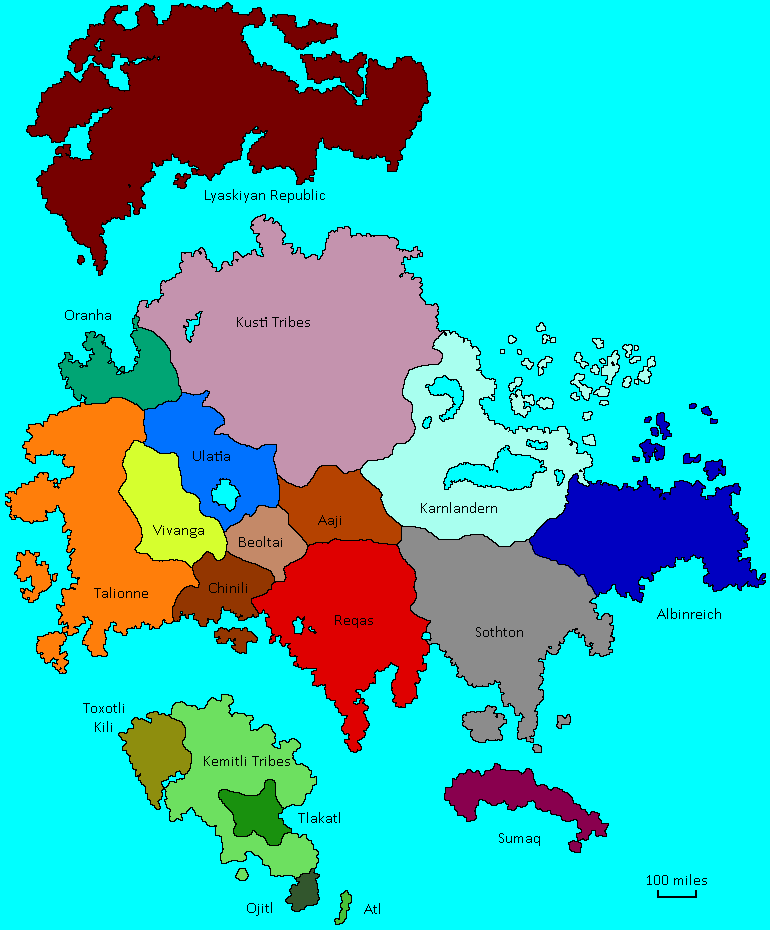
This thread is basically me trying to write out a concept of a setting that has intrigued me basically from the moment it came to my mind. It will not be properly narrative, nor will it be a timeline. While history will come up, it's more "things that are important recent events" than a timeline where the ultimate fate of this nation or that is waiting to be revealed.
Effectively, the idea of the setting is to take a modern world and impose upon it the common tropes of fantasy - numerous nonhuman races, pervasive magic, polytheism with traces of henotheistic practice, and so forth - while maintaining a recognizable modernity. This isn't an Eberron type setting, where magic takes up the role of technology, nor is it a story of our own world's secret (or not so secret) underbelly like True Blood or Dresden Files or Persona. It's closer to something like Shadowrun (sans the cyberpunk elements) or Final Fantasy XV: there's cars, trains, cell phones, internet, and there's also elves, orcs, evil gods, wizards, and dragons.
The broad thematic notes, as I currently see them, are:
- Nations are generally Earthlike. They have major industries, commercial trade, complex legislative and judicial systems, professional or conscript militaries, mass politics, secular governance, etc. Where they aren't, they should be coded as holdovers from older systems of governance, not as e.g. mageocracies.
- Fantasy races are generally treated as ethnic minorities. They are not meant to be coded as specific real world ethnic minorities and will typically borrow from multiple relevant subcultures as well as the relevant tropes for their specific race.
- Magic exists and is a skill but does not replace unskilled labor. Factories work like real world factories, industries generally work like real world industries, there are waiters not magic servitors. Where magic interacts with the market it primarily supplants or intersects with areas we would associate with skilled labor - geological surveys, movie stunts, psychiatric care, and so forth.
- Magical items are an artisinal industry that has not been phased out by mass industry.
- The gods intervene rarely, but definitively exist and are frequent objects of veneration. Religion is, broadly speaking, cultural rather than philosophical - the gods are not seen as terribly moral figures by most people, though certain more henotheistic subcultures do view their gods in such a light.
The current year in the setting is 2018, and you can use our own history as a rough timeline of technological and social development.
That out of the way, let's get started with the most important things: a map, and a dark lord.
Merkass is the central region/polity of the setting. While presumably other countries exist beyond its borders, I shan't be concerning myself with those for now, if ever.
The Dark Lord Mansur
Emir Mansur - known nowadays by the epithet assigned to him by Talionne and soon adopted by all the opposing armies, "the Dark Lord" - is likely the most important figure of the twentieth century in Merkass, certainly of the latter half.
Mansur began his life as a minor member of the old royal family of Reqas, seventeenth in the line of succession, but acquired a major public following in the economic turmoil of the late 1970s. Reqas had relied heavily on its oil exports for its government's budget, and with the collapse in oil prices, it was left to attempt wildly unpopular austerity measures. Drawing on this natural wellspring of discontent and radicalization, Mansur positioned himself as a figure of anti-austerity and was eventually embraced by the business classes of Reqas as a figure who could tamp down on this discontent without coming after them.
And tamp down he did. Having taken power in the seventh month of 1978, he had by the ninth month of 1979 pacified the population, murdered all his rival claimants to the throne to the last, and established himself as the absolute dictator of Reqas. He embarked on a major campaign of industrialization and armament, which culminated with the invasion of his northwestern neighbors, the Sindao Confederation nations of Aaji, Beoltai, and Chinili, in the sixth month of 1980.
From there, the other major powers of Merkass soon created an alliance, seeking to encircle Mansur, but ultimately failing - by clever geopolitics, by the first month of 1985, he was the almost unquestioned ruler of most of Merkass, even controlling Vivanga, long a client of Talionne. Only Albinreich in the East and Talionne in the West yet maintained their independence, and he viewed them as soon to fall. His ultimate loss was not purely due to mortal affairs - but then, neither was his ascension.
Mansur, like many in Merkass, venerated the god Mammon. Although Mammon is of the Nephine tribe of gods - the so-called "good" gods - he is only loosely beneficent. He is a god of unrestrained greed, among other things. Mansur called Mammon first among the gods he worshiped, but he did not, like most Mammon-worshipers, also worship the other Nephine gods. Instead, he broke bread with the Lucifene - the so-called "evil" gods - for magical power which he used to crush the other nations of Merkass. He even summoned over a hundred thousand demons from Hell, having them serve as elite soldiers in his army, regardless of their age or sex, and they looted and conquered on his behalf until his defeat.
Then came the hero chosen by the Nephine, Garic. A young infantryman of nineteen years, serving faithfully in the Albinreichen Army, he was blessed and given the power of the Godsblade, a divine weapon bound to his soul, which could cut through anything he wished it to. In a lightning strike on the Osin Palace in early 1987, he slew Mansur in personal combat.
Although his armies continued to fight on, for a time, the tide had irrevocably turned, and those who succeeded Mansur to power recognized this, quickly bringing about an end to the war. He is remembered fondly only by a minority of Reqasi, most of whom see him as responsible for their national humiliation and disarmament. His secret practice of infant sacrifice to the evil god Moloch, though only killing some two hundred infants over the entire course of the war, has certainly helped later propagandists cast him as a wicked monster who tricked the people of Reqas.