
• An addendum to Rule 3 regarding fan-translated works of things such as Web Novels has been made. Please see here for details.
  • We've issued a clarification on our policy on AI-generated work.
  • Our mod selection process has completed. Please welcome our new moderators.
  • The regular administrative staff are taking a vacation, and in the meantime, Biigoh is taking over. See here for more information.
  • Due to issues with external spam filters, QQ is currently unable to send any mail to Microsoft E-mail addresses. This includes any account at live.com, hotmail.com or msn.com. Signing up to the forum with one of these addresses will result in your verification E-mail never arriving. For best results, please use a different E-mail provider for your QQ address.
  • For prospective new members, a word of warning: don't use common names like Dennis, Simon, or Kenny if you decide to create an account. Spammers have used them all before you and gotten those names flagged in the anti-spam databases. Your account registration will be rejected because of it.
  • Since it has happened MULTIPLE times now, I want to be very clear about this. You do not get to abandon an account and create a new one. You do not get to pass an account to someone else and create a new one. If you do so anyway, you will be banned for creating sockpuppets.
  • Due to the actions of particularly persistent spammers and trolls, we will be banning disposable email addresses from today onward.
  • The rules regarding NSFW links have been updated. See here for details.
Oh I absolutely love this. Its nice to kinda map out Koron's limits. Obviously not Primarch level but maybe Titan level. The little comparisons to how things used to be are nice too. Hearing about Pre-Imperium and freedom of religion might actually break the Astartes.
Thank you! And yeah, one of the rules I put in place before I even started writing was 'Koron will never defeat a Primarch in combat.'
Primarchs and their level of existence I wanted to ensure would remain the top end :D
And the next chapter will help showcase how hes dealing with it, as his limit isnt at Titan level outside specific instnaces.
 
Chapter Sixty-Three New
Chapter Sixty-Three


Reminder dear listeners, the Voxbox remains open at all times!


For a heartbeat, the corridor noise fell away. The distant thunder of engines. The faint, constant complaint of floor-plates under stress. The shouting that always seemed to follow humans like exhaust. All of it dimmed under the simple, impossible quiet before him.

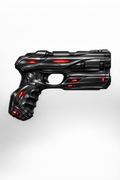
Koron's pistol had never looked like a weapon that wanted to be admired.

No aquila. No skulls. No devotional scrollwork to give violence a halo. It was a tool, in the same way a blade is a tool, and it wore that identity with quiet stubbornness: matte, almost light-eating alloy, edges softened where hands naturally found them, surfaces broken only by tiny marks that meant something to someone who knew how to read.

When Koron ran his finger down the top of the slide, it split along seams you could not see until they moved, nested arcs blossoming around a dark core, as if the weapon had been made with the same logic that taught flowers how to open without tearing themselves apart.

But the pistol did not simply come apart.

It unfolded.

Sections of the upper frame lifted and spread into a shallow orbit around Koron's hands, held there in such absolute balance that, for a moment, Helix's mind refused to classify what he was seeing as mechanism at all. Nothing snapped loose. Nothing sprang free. The pieces simply separated and waited, as though gravity itself had been informed that it was no longer in charge of this process.

Koron made a small motion with two fingers.

The pistol's heart opened for him.

Inside, there were no crude tracks or stamped levers worn shiny by use.

Instead, there was lattice and law.

A normal sidearm, once opened, revealed compromise. Springs. Tracks. Mechanical brutalities made portable.

This weapon revealed geometry.

A layered spine of latticed material ran down its length, a rigid backbone of pale metal that held the rest in tension. It wasn't machined so much as… grown, a fractal trusswork that reminded Helix of coral, of bone, of the honeycomb logic of things that had been optimized by time and brilliance and a refusal to accept waste.

The barrel, if you could call it that, wasn't a tube. It was a bore of nested rings, each ring etched with hair-fine grooves that weren't rifling but something stranger: shallow, repeating patterns that spiraled and then broke, spiraled and broke, notes of a melody written in mathematics.

Koron rotated his wrist a fraction, and the ring-stack turned in place without him touching it. The air held it. The pistol held it in concept, the way an oath holds a man even after the words are forgotten.

Along the bore sat a set of field coils that did not look like coils. There was no finely spun copper or metal etchings. Rather, thin, pale bands embedded into the structure, as if someone had drawn them with a pen of condensed moonlight and then told the matter to hold still forever. Each band had a tiny alignment notch, and each notch corresponded to marks on the frame so small an Imperial artificer would need a magnifier just to believe they existed.

When Koron reached for one of the bands, he didn't touch it.

He asked the local gravity to move it.

The coil-band slid free and rose into a waiting position, rotating until its alignment notch kissed the angle he wanted, stopping with a soft, decisive thrum.

There was a power core, but it wasn't a cell you could pull out and replace like a laspack. It was a sealed wafer tucked into a cradle of shock-damping gel, with two conduction paths that met it like veins. The wafer's surface was patterned in squares and arcs, a patchwork of microscopic gates that made Helix's implant-fed diagnostics itch with recognition.

It wasn't a battery, not in the way the Imperium meant it.

It was a reservoir. A patient, private lake of stored violence.

Koron made a subtle pulling gesture and the wafer drifted out of its gel-cradle, smooth as silk over steel. The gel didn't tear or string. It simply let go, as though the material had been instructed, long ago, to understand that sometimes the heart must be removed and examined and returned without panic.

A second gesture drew out a keyed module no larger than his pinkie nail, and on its face—no, not its face, its interface—there were only three symbols, stamped so cleanly they looked like part of the metal.

A line.

A circle.

And a small, jagged mark like a lightning strike caught in amber.

Helix could feel the philosophy in it.

Minimalism so severe it became its own kind of arrogance. Not because it wanted to intimidate you, but because it assumed you were competent enough to understand.

The shapes weren't labels.

They were axioms.

His sensors painted the interior in layers: thermal sinks nested behind the focusing assembly, self-healing conductive channels braided through the frame, actuators capable of reseating components within tolerances measured in microns.

The redundancy was there, but not in the Imperial sense of adding mass and hoping piety bridged the rest. This was redundancy of principle. Multiple paths. Multiple solutions. Multiple safe failures, all circling the same quiet assumption:

This device was expected to survive the death of worlds.

Koron adjusted one segment—just a hair of rotation on a ring that didn't look important until you understood what a hair meant at that scale. The ring obeyed, then clicked without touching anything. A field-lock disengaging. A limiter released.

Technomancy, if you required superstition to survive understanding.

Engineering, if you did not.

Koron's care with it struck Helix almost as hard as the workmanship itself. He handled the pistol with neither reverence nor casualness, but with the exact respect due to a thing that could do the impossible and did not need to boast about it.

Helix should have felt anger. That was the common reaction. Anger was safe. Anger fit inside a doctrine.

Instead he felt something older than anger, something that lived beneath his steel and his certainty.

Wonder.

The kind that hushes you because you're afraid sound might crack the glass.

+Who taught it to do that?+ he asked, and his binharic voice sounded smaller than his chassis.

Koron didn't look up.

"I did," Koron said, the words emerging almost as a side effect, his thoughts elsewhere.

The Archmagos froze.

That answer was a doctrinal rupture.

The pistol could be called archeotech. A relic. A miracle. A problem. Those were all containers. Those were things you could quarantine, bless and file away.

But "I did" meant there was no container.

It meant there was a craftsman standing in front of him.

A living, breathing origin.

An explosion rolled through the adjoining level. Dust sifted from the ceiling. Somewhere farther off, lasfire snapped out in hurried bursts.

Helix barely registered any of it.

His optic shutters tightened in focus. In the sudden, hungry intensity of a man who had spent centuries sifting ash for splinters, and had just seen a tree.

+You built it.+ He said. It came out as a statement, not a question. He wasn't accusing. He was anchoring himself to the fact.

Koron made a small, distracted sound as he completed another adjustment, even as the crack of lasfire tried to drown his words. "Engineering school tradition."

Optical lenses flickered. +A… tradition.+

"First-year competency. You don't move on until you can build something that proves you understand the basics," Koron continued, still not looking up, focused on the tiny adjustments. "Gravimetric lattices. Quantum field matrices. Alignment tolerances that don't care what planet you're on."

His words were rushed, for he had not forgotten the battle around them.

Helix heard them like scripture.

Not because they were mystical.

Because they were clear.

Because they were what his people had been trying to reconstruct from broken hymns and half-memories, and sounded like the old stories before the stories were hollowed out to prayer.

His optics snagged on a detail so small it felt obscene beside everything else.

It was so simple that at first it offended him. A physical lever of steel and pressure tucked beneath a weapon that had just reordered local gravity and opened itself like a theorem proving its own elegance.

Koron could have made the pistol answer thought. Intention. Retinal lock, neural impulse, subvocal command, noospheric handshake, anything faster and cleaner and more advanced than this blunt human gate.

He had not.

Helix understood why a heartbeat later, and the realization froze in his coolant lines.

The trigger was not a limitation.

It was restraint.

One final, deliberate barrier between thought and consequence. A requirement that destruction still pass through muscle, through choice, through the oldest and simplest act of consent before it entered the world.

Not a god-weapon, then.

A weapon built by a man who knew exactly what power was, and refused to trust even himself too much.

For one brief, dangerous instant, Helix no longer saw a pistol in Koron's hands.

He saw an age.

Not clearly. Only a silhouette, but enough of one to wound him.

A civilization where such things had once been homework. Where elegance had not needed ornament. Where function had not been buried beneath prayer because function itself had still been understood. Where a man could build a weapon that turned gravity into a workbench and still think to leave a trigger in place because morals mattered more than convenience.

The feeling that rose in him then was too sharp to be hope and too alive to be grief.

Then a spent shell casing on the deck rolled half an inch toward Koron's hand.

And the room began to change.

At first it was so small Helix thought one of his optics had miscalibrated. A curl of dust on the deck did not settle. It turned, slowly, drawing a pale crescent across the metal. Beside it, a spent shell casing gave a tiny metallic tick as it rolled half an inch toward Koron's outstretched hand.

One of the candles in a wall-niche bent its flame sideways.

Helix's gaze snapped back to the pistol.

The open core had begun to glow.

A dim ember-red light, deep in the heart of the weapon, like something waking behind smoked glass. The suspended components still orbited in perfect obedience, but their calm now carried strain in it, the way a singer's held note carries the promise of a break if pushed one breath too far.

Another shell casing moved.

Then another.

Dust began to skitter over the deck in whispering lines. Ash lifted from a seam in the floorplate and drew inward. The candle flames all leaned now, not with the draft of a corridor vent, but with a single shared conviction.

Toward it.

Helix heard a rising whine from one of his attendant servitors as its stabilizers compensated for a force they did not understand. A torn scrap of parchment slid across the floor and vanished under Koron's boot. The deck plates gave a low complaint, stress fractures rapidly blooming in his auspex.

Koron did not move except to make one final adjustment inside the opened frame. Tiny red indicator marks along the weapon's spine lit in sequence, then dimmed, then lit again brighter, as if the pistol were taking deeper and deeper breaths.

The air tightened.

There was no other word for it. Pressure climbed without heat. Helix felt it in the seals of his augmetics, in the delicate inner whining of his sensorium, in the faint drag on every loose cable and hanging strip of cloth in the corridor. Reality was no longer merely being asked to behave.

It was being ordered.

A blue-white spark snapped across the open chamber.

Then another.

The arcs did not leap outward. They bent inward, dragged toward the dark red point at the pistol's center, where light itself seemed to hesitate. The glow deepened. Crimson now. Harsh enough to paint Koron's fingers in blood and turn the polished edges of Helix's metal hands black by contrast.

The shell casings were no longer rolling.

They were sliding.

Around them, the room began to tremble. Fine grit rattled across the deck. A hairline crack jumped through a loose wall panel. Somewhere overhead, a lumen tube burst with a sharp pop, and every shard of glass curved inward as it fell.

Helix stared.

Not at a weapon.

At an argument with gravity, winning.

Then the larger pieces began to answer the weapon's call. Cracked panels tore free with shrieking snaps, breaking apart mid-air into spinning fragments that curved inward and vanished, one by one, into that pulsing core of blood light.

Helix felt his own footing begin to fail. His boots scraped for purchase as the deck seemed to tilt beneath him, though he knew it did not. His robes lashed wildly in the growing wind, cloth and cable snapping hard enough to sting against metal. His mechadendrites shot outward on instinct, locking around support struts with enough force to dent them, while behind him his attendant adepts grabbed for rails, piping, each other, anything that promised not to be dragged screaming across the chamber.

Then the air itself began to break.

Crimson-white discharges spat from the opened frame in vicious, whip-thin arcs, not random but bent, dragged, forced into impossible obedience by the thing forming at the pistol's heart. Helix's sensors flooded with warnings as local electromagnetic fields twisted and shrieked under the strain. Red lumen-glow peeled from indicator strips. Targeting runes dimmed as their light was torn free and drawn inward in streaming threads. Even the chamber's illumination changed, sinking into a strange, starved half-light as photons themselves were hauled down into that yawning crimson maw.

The weapon was no longer merely charging.

It was feeding.

The deck shuddered. Seams split. Somewhere behind him, a lumen fixture burst, and the shards did not fall. They turned in the air like iron filings finding a magnet and went hissing toward the core.

Koron's feet left the deck. He rose until his back pressed flat to the ceiling, boots braced against the wall with deliberate precision. He settled there as though gravity had ceased to be a law and become, at most, a preference.

Then his armor moved.

Metal flowed over his right arm and shoulder in a seamless tide, thickening, hardening, locking into place as braces punched outward and bit deep into the ceiling behind him. The roof groaned at the contact. Restraints unfolded around him with brutal efficiency, not to protect him, Helix realized, but to keep him from being torn apart by the thing in his hand.

Koron's features were exposed now, stripped bare of the helm. Sweat spilled down his face in quick, bright lines. His jaw was locked, teeth gritted, and his firing hand shook with the force of it, tiny violent tremors driven up through muscle and metal alike as the pistol's rising fury rattled through his arm and into the marrow of his bones.

Then he leveled the pistol at the floor.

At the Titan.

Nearly two hundred kilometers distant.

Koron's voice cut through the gale over the noospheric link, wire-tight as his eyes narrowed in focus. 'Get back!'

Helix was already hauling himself away before he realized it, dragging his adepts with him by instinct. Mechadendrites lashed out, hooking robes, limbs, harness-rings, anything they could seize and rip backward.

Even so, he snapped back across the link. +What is happening?!+

'Not entirely sure!' came the reply, every word strained through gritted teeth. 'I've never fired it with the safeties disengaged!'

+...YOU WHAT?!+

The pistol answered for him.

The crimson point at its heart collapsed inward on itself so violently that the sound changed with it. The shriek filling the chamber rose past noise and into something Helix felt in his teeth, a pressure-scream that made his optics stutter and his internal gyros twitch in protest. The open frame around Koron's hand no longer looked like a weapon being charged.

It looked like a mouth learning how wide it could open.

The room came apart.

A section of floor three meters across tore upward in one savage convulsion, deck plating ripping free from its anchors with a scream of tortured metal. It did not simply break loose. It was skinned, the surface peeling back in jagged layers as bolts snapped, reinforcement bars bent, and whole slabs of steel were dragged into the air. The rising mass spun once, caught in the weapon's pull, and shattered into a storm of fragments before it ever reached Koron.

Every piece vanished into the shrieking red core.

The wall followed.

Brass reliefwork, shattered pipe housings, armored conduit trunks, prayer niches, data plaques — all of it ripped free in chunks and sheets. A support rib burst from the masonry with enough force to fling two attendant servitors sideways, only to be caught mid-flight, twisted ninety degrees, and drawn inward in a spray of molten sparks. A row of lumen fixtures tore from the ceiling as one, their housings spinning, their glass exploding into glittering arcs that should have fallen and instead curved upward into annihilation.

Helix felt the pull through his own frame now.

His robes snapped flat against his chassis. Every loose cable, every hanging censer-chain, every strip of cloth and parchment in the chamber whipped toward Koron hard enough to crack like lashes. His boots shrieked across the deck despite the mag-locks, carving bright scars in the metal as he fought for purchase.

Behind him, one of the adepts screamed as a mechadendrite was caught in the growing pull. The articulated limb stretched taut, joints locking one after another, then tore free at the shoulder with a wet metallic wrench. It pinwheeled once through the red-lit dark and vanished into the core before the blood had even finished spraying.

Red warning lumens peeled from the walls in streaming bands, their glow dragged bodily across the air and fed into that impossible point in Koron's hand. Targeting sigils winked out across Helix's vision as the sensorium struggled to compensate for local reality falling into nonsense. Electromagnetic warnings flooded his internal displays. Structural failure. Field collapse. Gravimetric breach. Material erosion. Optical distortion. Noospheric corruption. The machine-spirit did not know what category this belonged in, and so it screamed all of them.

A crack raced across the deck overhead with the speed of lightning. Then the whole panel sagged, bulged downward, and burst apart. Chunks of armored roofing the size of coffins plunged toward the deck — only to halt, shiver, and reverse direction with bone-jarring suddenness. They shot upward instead, accelerating straight at Koron in a spinning barrage that should have crushed him flat against the ceiling.

The pistol devoured them.

Each fragment that reached the core simply ceased to have shape. Iron, ceramic, composite, brass, sacred oil, dust, paint, all of it stripped down and swallowed so completely that the eye could not follow where matter ended and energy began. The red-white arcs around the core thickened with every offering, crackling now in whip-like tendrils that lashed inward and vanished into the shrinking, blazing center, the room shaking as the pull strained the tower to its limits.

Koron's arm shook harder.

The braces locking him to the ceiling groaned under the strain. Metal bit deeper into the structure. Hairline fractures jumped through the armor cocooning his shoulder and forearm, immediately sealed by flowing plates only to split again under the next surge. Sweat ran from his chin in shining droplets and did not fall. They lifted from his skin, caught the crimson light, and vanished into the core like blood offered at an altar built by physics itself.

Still Koron held his aim.

Still the pistol drew more.

A whole section of wall to Helix's left ripped outward in a thunder of collapsing masonry. The force of it flung one Skitarius into the air, limbs pinwheeling, his rifle spinning from numb hands. Helix moved without thought. A mechadendrite punched through the gale, caught the trooper by the harness, and slammed him bodily into the bucking deck behind a half-sheared support strut a heartbeat before both rifle and broken wall vanished into the eager core.

And at the center of it all, pinned to the ceiling like a man being crucified by his own invention, Koron drew one ragged breath and tightened his finger around the trigger.

The screaming core went white at the edges.

Helix's remaining organic tissues tried to recoil inside him.

The charge had climbed beyond any sane measure now. The numbers scrolling through his sensorium meant nothing; they were only different ways of saying too much, too fast, too late. Every instinct he possessed, human and machine alike, shrieked that the next heartbeat would end in one of two ways:

The Titan would die.

Or this entire section of tower would.

The chamber went still.

The screaming core in Koron's hand snapped inward upon itself. The gale vanished in a single violent instant. Dust stopped in the air. Splinters of metal and stone hung where they had been thrown. The crimson-white arcs writhing around the opened frame locked in place, thin fractures trapped in place as though the air had turned to glass.

For one heartbeat, the tower forgot how to move.

Koron pulled the trigger.

The universe tore.

Helix never truly saw the shot leave the weapon.

Later, he would tell himself that he had. That a three-meter pillar of deep crimson light had erupted from the pistol, black streamers twisting along its edges and a white core burning at its heart bright enough to scar the soul. That was what his optics recorded. That was what his mind, in self-defense, preserved.

But in the instant itself, what happened was simpler.

And far worse.

Something tore a line through the tower before light had time to follow.

The discharge hit the floor beneath Koron and the deck simply ceased to matter. Ceramite, adamantium, brass, sanctified plating, data conduits, armored ribs, shrine recesses, support columns — all of it vanished down the same impossible throat in a single act of enforced consequence.

There was no explosion.

Rather, a perfectly cylindrical absence punched straight down through the spire's body, as though a god had driven a red-hot spear through a cathedral and left the wound open behind it.

Then the aftereffect arrived.

That column of deep red light snapped into being through the new-made shaft, extending downward beyond sight. Black streamers crawled and writhed along its outer edges like tears in the skin of the world that had forgotten how to close. At its center burned a furious white so dense it looked less like light than a verdict.

The sound followed a fraction later.

A bass bellow rolled up through the tower so deep Helix felt it in his inner fluids before he heard it, a monstrous, tectonic roar with a shriek braided inside it, high and thin and merciless, like stressed reality screaming through clenched teeth. Every floor below them answered at once. Deck plates burst. Windows imploded. Shrine lamps shattered. Entire sections of corridor wall blew outward into the shaft and vanished into the descending wound of light.

The orbital spire was being punched through.

Not one floor.

Not ten.

All of it.

The scarlet column bored downward through one level after another, drilling through command decks, transit spans, sanctums, habitation rings, lift shafts, ammunition vaults, maintenance arteries, data shrines, and armored support webs in a straight, unforgiving line that ignored both mass and meaning. Helix glimpsed it only in fragments through his noospheric feed: whole floors opening like split fruit, concentric shockwaves racing through sacred architecture, streams of molten metal and atomized stone being dragged into the wake of the shot as it descended.

The spire did not merely shake. It convulsed.

Then, far below, through stolen machine-sight and seared sensor ghosts, Helix saw the beam reach the battlefield.

The Reaver Titan had just enough time to begin turning.

For one absurd instant, its shields held just long enough to announce their own irrelevance. Harmonic layers flashed into existence around the impact point in brilliant overlapping shells, each one collapsing faster than the last as the shot bored through them without slowing, punching through void, armor, pistons, sacred plates, joint housings, and the colossal knot of motive assemblies beneath the knee.

The leg folded with sudden, catastrophic wrongness. Thousands of tons of war-engine lost the argument with balance in a single heartbeat. The Reaver lurched sideways, its massive frame twisting as the ruined limb collapsed under it, and the battlefield bloomed into fire, debris, and screaming machine-voices.

Above, in the chamber that had birthed the shot, Helix could only stare.

Koron still hung pinned to the ceiling, arm locked forward, smoke and crimson afterlight pouring around him.

And Helix understood, with the first cold edge of a realization that would haunt him long after the battle ended, that he had not just watched a miracle.

He had watched a man fire a sidearm through an orbital spire.

For one impossible second, the chamber forgot how to be a place.

The wind curled. The superstructure groaned. Dust drifted and the slow rain of debris clattered through the red-lit shaft below. Fragments settled somewhere in the broken dark with tiny, uncertain ticks. Overloaded systems began returning in stuttering bursts, one by one, as though the tower itself were trying to remember what rules still applied.

And above it all, Helix heard the wet, ragged hitch of Koron's breathing.

Then the steam began.

It hissed from the opened seams of Koron's armor in harsh white jets. He was still pinned to the ceiling by the recoil braces, one arm locked forward, the pistol hanging smoking in his hand like the afterimage of a crime. Sweat ran down his face in sheets, cutting through blood and dust. Blood had spilled from his nose and from the corners of his eyes alike, bright against skin gone grey with strain. His chest rose in shallow, broken pulls, one side hitching wrong enough that Helix's diagnostics tagged cracked ribs before thought caught up.

Worst of all was the arm.

The right shoulder had come half out of joint despite the braces locked around it, the limb hanging at a grotesque angle for one sick heartbeat before the armor's stabilizers caught and held it in place. Even then the hand still trembled around the pistol, not with weakness, but with the violent aftershocks of something no human frame had ever been meant to contain.

Even wrapped in all that impossible engineering, flesh had still paid a blood price.

Below them, far below, the noosphere continued to scream with consequences. Collapse warnings raced through the wounded architecture of the spire. Emergency bulkheads tried and failed to understand what had happened to the floors beneath them. Sensor ghosts flashed with the image of a Reaver Titan laying sideways in a storm of debris, its knee no longer present in any meaningful mechanical sense.

Helix looked from those broken feeds back to the weapon in Koron's hand.

Not a relic mounted in a shrine. Not some battlefield abomination rolled out on tracks and prayers.

A weapon small enough to ride on a man's thigh.

A thing built to be carried, drawn, and used.

The thought struck him harder than the shot itself.

A memory surfaced from some old, half-sealed vault in his mind: a workshop on Mars, back when more of him had been flesh, all coolant tang and scorched oil and the patient hands of a mentor correcting his grip on a tool. You do not pray because the machine is fragile. You pray because you are. The rite is only there to hold your attention. What matters is that you understand what your hands are doing.

Then the memory was gone, drowned under the present.

Because that was what stood before him now.

Understanding.

Mars had spent ten thousand years clinging to broken instructions, to fragments, to ritualized repetition born not of stupidity but of desperation. They had kept the embers alive with prayer because prayer was what remained when comprehension failed. They had built a raft from splinters and driftwood and called it doctrine because the alternative was drowning in the dark ocean.

And now Helix stood inside the wreckage of an orbital spire and looked up to see the shoreline.

Not the whole of it. Not salvation, not yet.

One of the lesser Magi beside Helix made a shaken sound over the link, half-formed words crowding behind it. Contamination. Heretek. Blasphemy. The old reflexes, scrambling to put this new terror into an old box.

Helix silenced him with a single burst of binharic command.

Not now.

Not when the truth was still bleeding in front of them.

He took one step nearer, then another, boots ringing softly on the scarred deck. To stand close enough that the reality of Koron's injuries could not be reduced into abstraction.

The blood at the eyes.

The sweat.

The steam.

The half-dislocated arm trembling around a pistol that had just punched through one hundred and eighty kilometers of sacred architecture and removed a Titan's knee from the argument.

Flesh had paid for the shot. Flesh always paid. That, more than anything, made the moment real to him.

Helix inclined his head.

It was not worship. It was not surrender.

It was respect stripped down to its oldest and cleanest shape.

+Builder,+ he said quietly.

The word left him before doctrine could object.

Koron's head turned a fraction. His expression was tight with strain, eyes glass-bright with pain, mouth already tightening into the look of a man who suspected philosophy was about to become inconvenient.

"That tone," he said hoarsely, "usually means you're thinking something complicated."

A dry crackle passed through Helix's vox.

It might once have been laughter.

+Of course I am,+ he said. +I belong to Mars. Complexity is how we show affection to a problem.+

Koron shut his eyes for one brief second, whether in pain or resignation Helix could not tell.

Helix looked again at the pistol.

Student work. First-year competency. A thing built to prove understanding of principles. Helix's processors tried to place the thought somewhere safe and failed utterly.

If this was a sidearm, then the past had not merely been mighty.

It had been coherent.

That was the part that almost undid him.

Not the power. Power alone was easy to worship. Easy to fear.

Coherence was harder.

Coherence meant the old stories had been true in ways even Mars no longer dared articulate. It meant there had once been an age where elegance and force, restraint and capability, understanding and creation had all belonged to the same human hand without contradiction. An age where a man could build a weapon that tore a god-engine out from under itself and still leave a trigger in it because consequence ought to pass through flesh before it entered the world.

Helix felt something shift inside him then.

For one dangerous instant he remembered what his order had once been reaching toward before fear and loss made liturgy out of survival.

Builders.

Makers.

The patient hands that had once dragged humanity upward by understanding instead of begging.

He opened a private channel to his disciples.

+Do not transmit this,+ he said.

He could feel their confusion immediately, sharp and frightened.

+Not because it is shameful.+

He watched the steam pour from Koron's armor. Watched the fine tremor in the ruined arm. Watched blood track down the face of the man who had just shown him a road back to a world so much larger than the one Mars had inherited.

+Because hope is fragile,+ Helix said. +And fools stampede faster than they kneel.+

He closed the channel.

There would be arguments after this. There would be denunciations, claims, schisms, ecstatic prayers weaponized into politics. Mars would do what frightened institutions always did when confronted with living proof that their maps were incomplete.

But Helix could no longer pretend the map ended here.

He stood in the ruins of a tower that had just been pierced from crown to root by a pistol small enough to fit in one hand, and looked up at the broken, breathing man still clinging to the ceiling.

In this moment, in this small pocket of calm where a pistol had become a floating diagram of a better world, the Archmagos allowed himself something he had not permitted in a very long time.

He allowed himself to believe that the past was not only a tomb.

That somewhere inside it, a workshop door still flickered with light.

And that, bleeding and broken before him, was a man who knew the way back.
 
And, for fun, this is how I picture his pistol to look like when its not being purposefully overload :D
 

Users who are viewing this thread

  • Back
    Top